'%3e%3cpath%20id='Vector'%20d='M11.474%207.12258C11.5964%207.0054%2011.6667%206.84133%2011.6667%206.66946C11.6667%206.49758%2011.5964%206.33613%2011.474%206.21633L6.89063%201.84133C6.64063%201.60175%206.24479%201.61217%206.00781%201.86217C5.77083%202.11217%205.77865%202.508%206.02865%202.74498L9.48177%206.04446H0.625C0.278646%206.04446%200%206.3231%200%206.66946C0%207.01581%200.278646%207.29446%200.625%207.29446H9.48177L6.02604%2010.5913C5.77604%2010.8309%205.76823%2011.2241%206.00521%2011.4741C6.24219%2011.7241%206.63802%2011.732%206.88802%2011.495L11.4714%207.11998L11.474%207.12258Z'%20fill='%23FCFCFC'/%3e%3c/g%3e%3cdefs%3e%3cclipPath%20id='clip0_0_36'%3e%3crect%20width='11.6667'%20height='13.3333'%20fill='white'/%3e%3c/clipPath%3e%3c/defs%3e%3c/svg%3e)


'%3e%3cpath%20id='Vector'%20d='M31.999%2031.9996H0V0H31.999V31.9996Z'%20fill='%23FF6600'/%3e%3cpath%20id='Vector_2'%20d='M9.26953%207.85547H11.7751L14.9995%2014.3543C15.4707%2015.3217%2015.8677%2016.2643%2015.8677%2016.2643C15.8677%2016.2643%2016.2896%2015.3466%2016.7854%2014.3543L20.0599%207.85547H22.3916L16.8597%2018.249V24.8719H14.7517V18.1249L9.26953%207.85547Z'%20fill='white'/%3e%3c/g%3e%3c/g%3e%3cdefs%3e%3cclipPath%20id='clip0_0_7'%3e%3crect%20width='32'%20height='32'%20rx='5'%20fill='white'/%3e%3c/clipPath%3e%3c/defs%3e%3c/svg%3e)





Finding the right HRIS can save weeks of admin and keep you compliant across states and countries. This hris vendor comparison gives you a practical way to build a shortlist, score vendors, and choose with confidence. It also highlights where an HRIS now overlaps with payroll, global hiring, and recruiting so you do not stitch together six tools when one will do.
If you want to see what an integrated stack looks like in practice, you can explore the all in one approach from Bolto.
How we evaluate HRIS vendors Why trust this comparison
A strong hris vendor comparison should be transparent about methods. This guide draws on buyer checklists used by growing US companies, plus recent market facts from credible sources.
Facts that inform this framework
-
The global average cost of a data breach reached 4.88 million in 2024, up 10 percent year over year. Security and access controls are not optional. (newsroom.ibm.com)
-
US organizations still face the highest breach costs, averaging 9.36 million per incident. (cfo.com)
-
Pay transparency rules are expanding, with 14 states plus DC having laws in effect or taking effect in 2025, which raises configuration needs for job posting workflows and pay ranges. (paylocity.com)
-
Thirteen states plus DC have enacted paid family and medical leave programs, which complicates leave policies and payroll settings for multi state employers. (americanprogress.org)
-
IRS failure to deposit penalties range from 2 percent to 15 percent based on lateness, which underscores the need for automated tax deposit scheduling in payroll modules. (irs.gov)
-
Typical HRIS implementation for SMBs takes about 4 to 14 weeks, with 6 weeks common at BambooHR. Mid market projects often land in the 3 to 6 month range from research to go live. (bamboohr.com)
-
A widely cited McKinsey view notes about 70 percent of large change programs miss objectives, usually due to people and leadership factors. Treat HRIS rollout as a change program, not just a tool swap. (mckinsey.com)
-
The median HR to employee ratio benchmark is about 1.4 HR staff per 100 employees, which explains why lean teams value automation and consolidated platforms. (moreton.com)
For companies that want recruiting, payroll, and global HR in one place instead of separate point tools, consider a demo with Bolto.
What to compare selection criteria and 2025 feature checklist
Use this structured view to keep your hris vendor comparison objective.
Core areas to score
-
Employee record and workflows, profiles, org charts, document storage, e signatures
-
Payroll, US multi state taxes, filings, garnishments, year end forms
-
Time, attendance, leave management, accruals, state leave policies
-
Benefits, enrollment, carrier connections, ACA reporting
-
Talent, recruiting or ATS integrations, onboarding, performance and goals
-
Global capabilities, contractor payments, entity free hiring, EOR or COR support
-
Compliance, pay transparency, paid family leave, overtime rules
-
Security, SSO, role based access, audit logs, data retention
-
Reporting and analytics, custom fields, export options
-
Integrations and API, finance and accounting, collaboration and identity tools
-
Support and services, SLAs, hours, dedicated manager
-
Pricing and TCO, modules, base fees, per employee fees, implementation
2025 HRIS checklist
| Category | What to look for |
|---|---|
| Payroll and taxes | Automated deposits and filings, clear calendars, alerts for missed deposits, support for locality taxes and reciprocity when applicable. Late deposit penalties can reach 15 percent, so controls matter. (irs.gov) |
| Compliance guardrails | Pay transparency fields in job posts and internal ranges, state specific leave and PTO templates, paid family leave program support where required. (paylocity.com) |
| Security | SSO, MFA, field level permissions, audit trails, breach response plans, and data residency options. Breach costs are rising which increases the value of preventive controls. (ibm.com) |
| Global employment | Contractor payments in multiple currencies, local tax forms, and the ability to add EOR or contractor of record when you hire abroad. |
| Analytics | Prebuilt headcount, payroll, and equity views, plus custom reports and scheduled exports to your data warehouse. |
| Extensibility | Open API, webhooks, and turnkey integrations with accounting, identity, and collaboration systems. |
| Implementation | A plan that fits your size, from self service to guided to white glove, with a clear timeline and training plan. Typical SMB timelines are measured in weeks. (bamboohr.com) |
If you want a unified stack with recruiting plus payroll and global HR, you can start with a quick intro at Bolto.
How to choose the right HRIS for your company step by step
Follow this flow and keep your hris vendor comparison rigorous.
-
Define scope and success criteria
Write the three must win outcomes. For example reduce payroll errors, consolidate tools, or support hiring in two new countries. -
Map personas and workflows
Include HR, finance, IT, managers, and employees. List the top ten workflows you will test in demos. -
Build a short RFI
Ask for country and state coverage, payroll deposit controls, audit features, and data export patterns. -
Create a demo script
Use scenarios like run multi state payroll with a late hire, or set a pay range for a job in a pay transparency state, or onboard a contractor in Mexico then convert to employee. -
Score vendors with a weighted model
Weights often split across functionality, security and compliance, integration, usability, support, and price. -
Validate references
Ask for customers of similar size with the same pain points and similar states or countries (for example, see the Fiber AI case study). -
Pilot or paid proof
Time box a small rollout to one team or one entity. Measure admin hours saved, error rates, and cycle time. -
Final negotiation
Lock pricing tiers and renewal caps, confirm SLAs, and get a firm implementation plan and named resources.
If you need recruiting and payroll together, test a unified scenario with Bolto so you can compare a single vendor against a multi vendor stack.
Pricing and total cost of ownership
Use real prices and include the hidden items.
Visible software costs
-
Base platform fee plus per employee per month for core HR and payroll
-
Add ons like time, performance, benefits admin, or device management
Illustrative public list pricing snapshots. For a deeper breakdown of models and hidden fees, see our guide to payroll services pricing.
-
Rippling commonly shows a base platform near 35 dollars plus about 8 dollars per employee per month for Unity, with additional modules priced separately. (forbes.com)
-
Gusto Simple plan has been listed around 49 dollars per month plus 6 dollars per employee according to recent reviews. (techradar.com)
-
ADP RUN estimates vary, with third parties citing base fees near 79 dollars per month and 4 to 5 dollars per employee, but always confirm a formal quote. (comparisun.com)
-
EOR pricing at major vendors often ranges in the 500 to 700 dollars per employee per month band. For example, Gusto advertised 599 dollars per employee per month through December 31 2025 and notes a move to 699 dollars after that date. (gusto.com)
Hidden or variable costs to model
-
Implementation, data migration, and training
SMB implementations are often quoted in the 4 to 14 week range. (bamboohr.com) -
Integration and engineering time
Factor for SSO, accounting, identity, and data exports -
Change management
Underinvested change programs often miss objectives, so reserve budget for adoption and training. (mckinsey.com) -
Compliance risk and penalties
IRS late deposit penalties can add 2 to 15 percent on missed employment tax deposits. (irs.gov) -
Multi state tax complexity
Most states require withholding where the employee works and some enforce thresholds by days or wages, for example Arizona day thresholds and Idaho wage thresholds. (hrmorning.com)
Looking for a simple starting point for founders
Bolto focuses on early stage payroll and scales into global hiring so you have one login as you grow. Take a look at Bolto.
Implementation and change management essentials
Treat HRIS rollout as an organizational change, not just software setup.
Practical timeline anchors
- Guided SMB implementations often land in 6 to 12 weeks. Some vendors cite standard six week paths. Larger scope and integrations push toward a three to six month journey from research to go live. (bamboohr.com)
Keys to a smooth go live
-
Executive sponsor, clear outcomes, and a cross functional project team
-
Data cleanup before migration, decide on sources of truth
-
Role based permissions and SSO on day one
-
Pilot with one department, then stage the rollout
-
Train admins and managers, then record short how to clips for employees
-
Track three metrics after go live, payroll accuracy, cycle time, and ticket volume
Why the people side matters
- McKinsey observes that about 70 percent of large change programs miss objectives without strong leadership and engagement, so ensure communications and mind set shifts are part of the plan. (mckinsey.com)
Trends shaping HRIS comparisons in 2025
Security and privacy take center stage
Average breach cost rose to 4.88 million globally and the US remains the most expensive region, so security architecture and access controls belong in every demo script. (ibm.com)
Regulatory complexity
Pay transparency laws are expanding in more states, and paid family leave programs exist in over a dozen states plus DC, which pushes vendors to deliver more policy templates and dynamic pay range fields. (paylocity.com)
Consolidation and single vendor value
Companies want fewer tools. Buyers compare HRIS that can also run payroll, pay contractors, and support global hiring without opening three separate contracts.
AI assists and automation
From document classification to anomaly detection in payroll, AI is moving from demo to daily use. A quality hris vendor comparison should note where AI reduces manual checks and how the vendor handles auditability.
HRIS Vendor Comparison: Top 15 Vendors
Building on the criteria we just covered, this section lines up fifteen widely adopted HRIS platforms, from enterprise suites to SMB-focused tools, to show how they stack up across core HR, payroll, time, and talent. They’re grouped together because each is a credible, market-proven solution with distinct strengths in scale, configurability, global reach, and ecosystem fit. Use these snapshots to quickly shortlist vendors that match your size, complexity, and integration needs before you schedule demos.
1. Bolto HR
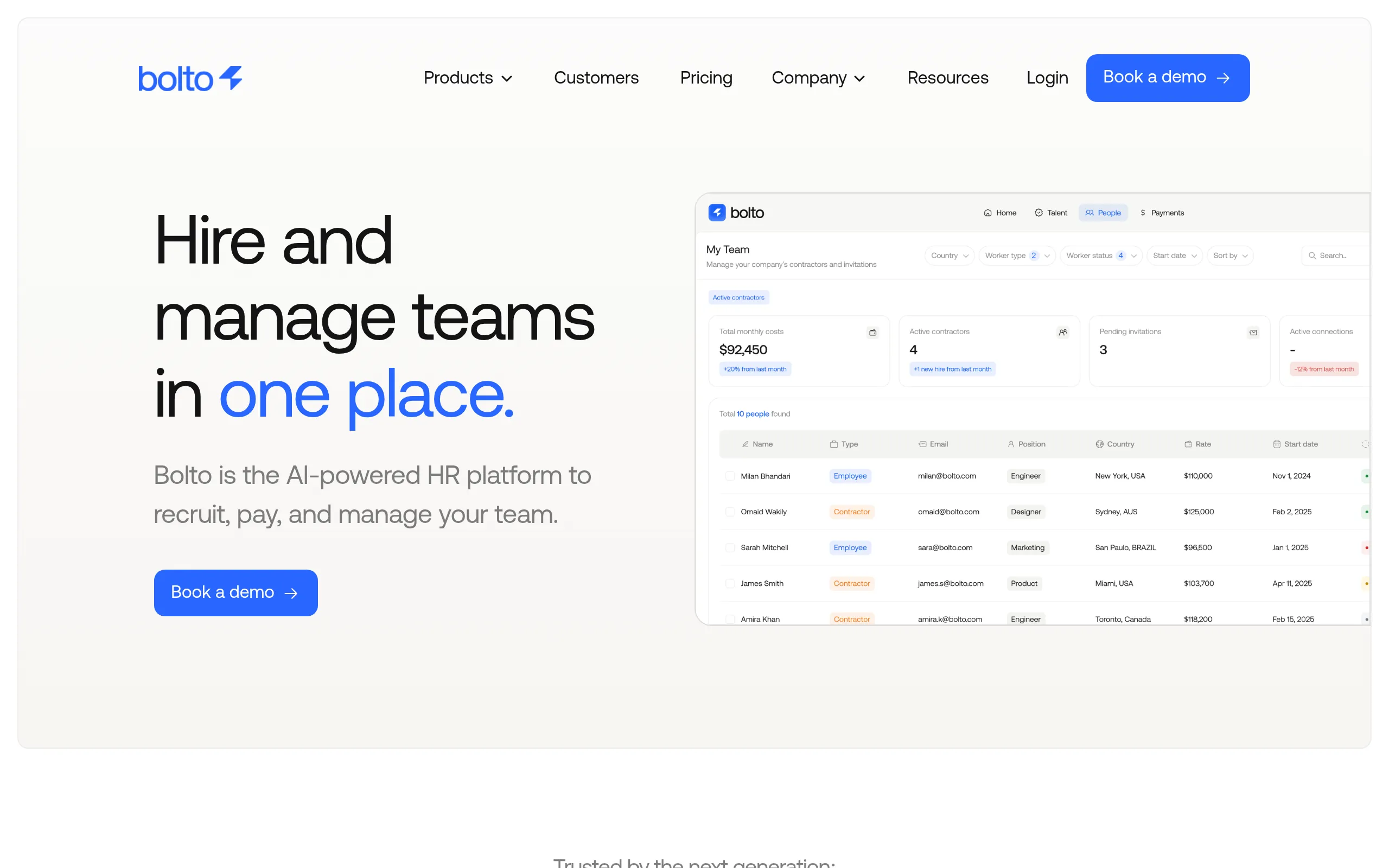
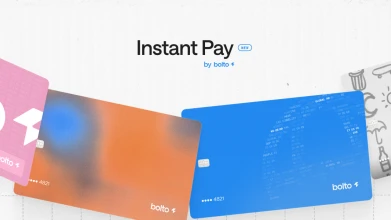
Bolto HR is the hub of Bolto’s all-in-one people platform, built for lean U.S. startups that want one place for HRIS, U.S./global payroll, EOR, contractors, and even recruiting. Fast setup, transparent pricing, and a hands-on support model make it appealing when you need to spin up multi-state payroll and cross-border hiring without adding HR headcount.
-
Quick facts: Best for US startups centralizing HRIS + payroll + EOR/contractors | Rating 8/10 | Pricing: HR $9, Payroll $29, EOR $599, Contractors $599/mo | Payroll: Yes | Benefits: Yes | EOR: Yes (~150+ countries) | Contractors: Yes | Integrations: HR/accounting (SSO unlisted)
-
What startups will like:
-
Core HR: centralized profiles, org chart, PTO/leave, policies, and lightweight workflows.
-
U.S. payroll: automated calculations, filings, and multi-state compliance for employees and contractors.
-
Global hiring: EOR in 150+ countries with localized contracts, payroll, benefits, and compliance support.
-
Contractor management: compliant contracts, tax forms, local-currency payouts, and invoice automation.
-
On/offboarding: checklists, documents, and policy acknowledgments in one place.
-
Reporting and integrations: basics for dashboards plus accounting connectors.
-
-
Pros: All-in-one HRIS + payroll + EOR/contractors + recruiting; quick time-to-hire with AI shortlists; transparent module pricing; dedicated support.
-
Cons: Younger vendor; SSO/specific connectors not fully listed; advanced HR modules are lighter; confirm exact country-by-country coverage.
2. Workday HCM
Workday HCM brings enterprise-grade HR, payroll, time, talent, and financials together on one platform, giving later-stage startups a single source of truth as headcount and complexity rise. It shines for U.S. payroll plus orchestrating multi-country runs through certified partners, with deep analytics, controls, and robust identity/security at its core.
-
Quick facts: Best for U.S. scaleups needing enterprise HRIS | Rating 10/10 | Pricing: By quote | Payroll: Yes (US, CA, UK/IE) | Benefits: Yes | EOR: No (partner ecosystem ~180+ countries) | Contractors: Yes | Integrations: ATS, NetSuite, Entra/Okta
-
What startups will like:
-
Configurable core HR with mobile self-service and SSO.
-
U.S. payroll with continuous calculation and multi-state filings.
-
Global payroll orchestration via Global Payroll Connect and certified partners.
-
Onboarding/offboarding, preboarding, and contingent workforce (Workday VNDLY).
-
Real-time analytics and dashboards; audit and compliance tooling.
-
Marketplace integrations spanning ATS/ERP/finance and security.
-
-
Pros: Enterprise-grade HRIS and payroll; class-leading global payroll integrations; strong compliance/SSO; unified workforce and financial visibility.
-
Cons: Higher cost and longer implementations; no native EOR; global payroll relies on partner network.
3. Oracle Fusion Cloud HCM
Oracle Fusion Cloud HCM is a comprehensive suite spanning core HR, talent, time, payroll, and analytics, making it ideal for startups maturing into multi-entity, multi-country operations. Its advantage lies in a single data model, strong U.S. payroll, expanding global payroll localizations, and tight linkage with Oracle Cloud ERP for end-to-end workforce-to-finance alignment.
-
Quick facts: Best for scaleups standardizing HR/payroll globally | Rating 4.5/5 | Pricing: By quote | Payroll: Yes | Benefits: Yes | EOR: No | Contractors: Yes | Integrations: LinkedIn, Oracle ERP, SSO
-
What startups will like:
-
Global core HR with localizations, currencies, and languages.
-
U.S. payroll with multi-state filings and year-end support.
-
Native payroll in select countries plus connectors to partner providers.
-
Journeys-based onboarding/offboarding, approvals, and document workflows.
-
Prebuilt analytics (Fusion Data Intelligence) across HR and finance.
-
APIs and SSO with Okta/Entra; LinkedIn and ADP connectors.
-
-
Pros: Unified HRIS with strong U.S. payroll; deep analytics and talent; seamless Oracle ERP integration.
-
Cons: No native EOR/contractor payouts; enterprise-style implementations; pricing is fully negotiated.
4. SAP SuccessFactors
SAP SuccessFactors is SAP’s cloud HCM suite for organizations operating across many countries, bringing core HR, payroll, talent, and time together with deep localizations. It’s a fit for U.S. startups scaling globally that want robust compliance, broad payroll coverage, and a clear path to integrate with SAP finance/ERP as they grow.
-
Quick facts: Best for U.S. scaleups and global enterprises on SAP ERP | Rating 10/10 | Pricing: By quote | Payroll: Yes | Benefits: Yes | EOR: Via partners (~180 countries) | Contractors: Yes (Fieldglass) | Integrations: ATS/Recruiting, S/4HANA, Okta SSO
-
What startups will like:
-
Global system of record with 100+ localizations and flexible workflows.
-
U.S. payroll with tax engines and multi-state compliance.
-
Broad native/global payroll plus partner EOR for fast entity-less hiring.
-
Onboarding with e-signature and U.S. I-9/W-4 support; alumni self-service.
-
Time and attendance, PTO, mobile apps; Story reports and OData.
-
Tight integration to S/4HANA and common ATS/SSO tools.
-
-
Pros: Wide payroll footprint; strong compliance automation; deep SAP ecosystem and reporting.
-
Cons: Higher cost and partner-led implementations; minimums for payroll; benefits often rely on third-party tools.
5. UKG Pro
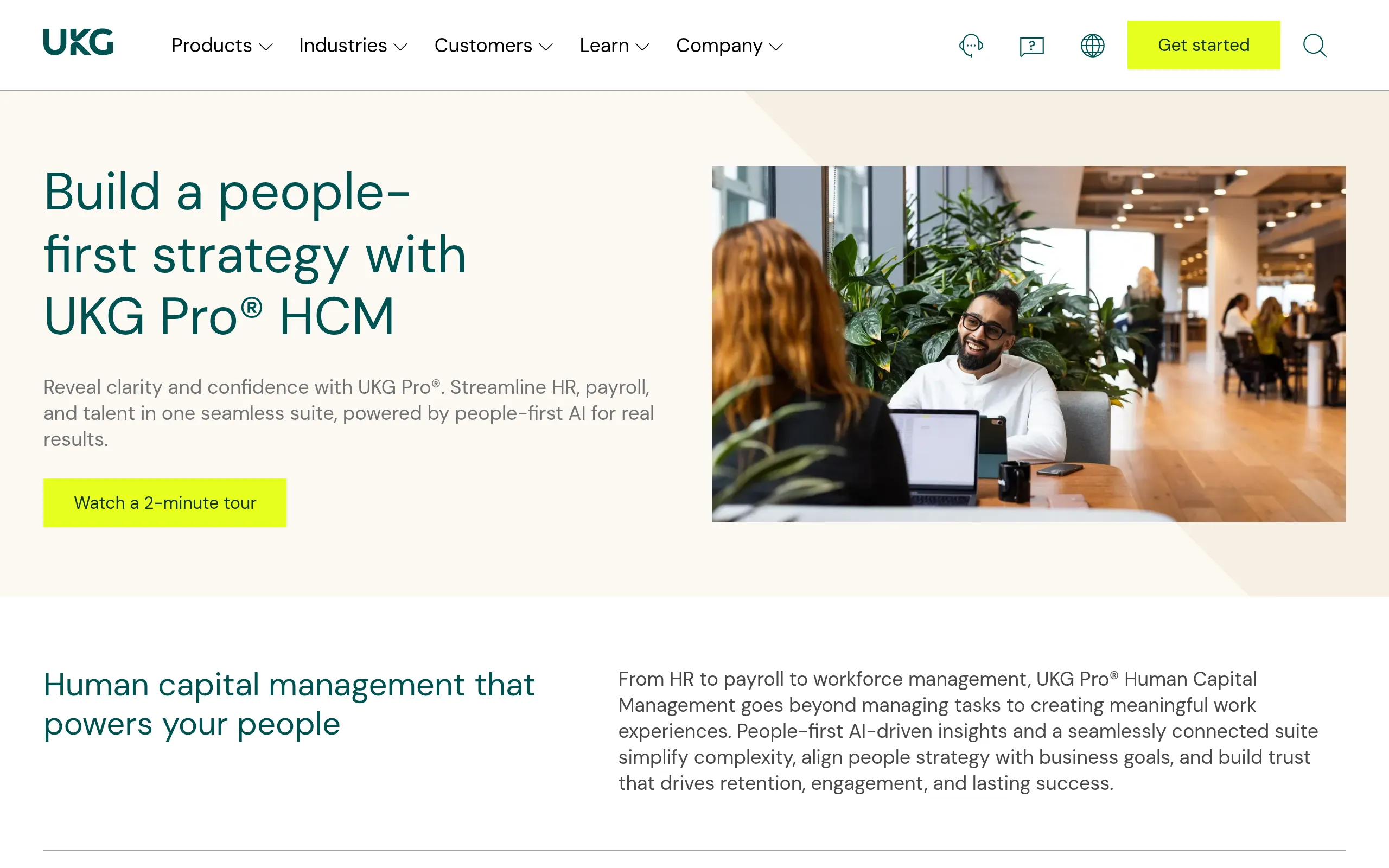
UKG Pro unifies core HR, U.S. payroll, talent, and workforce management, making it a strong choice for startups with hourly or distributed workforces. As teams expand internationally, UKG One View pulls multi-country payroll into a single layer for controls and analytics, while EOR comes through vetted partners.
-
Quick facts: Best for mid-market U.S. employers consolidating HRIS + payroll + WFM | Rating 10/10 | Pricing: PEPM (by quote) | Payroll: Yes | Benefits: Yes | EOR: No (partners) | Contractors: No | Integrations: Lever, QuickBooks, Okta
-
What startups will like:
-
Core HR with People Assist and Document Manager.
-
U.S. payroll with Payment Services for filings and year-end.
-
Global payroll aggregation in 160+ countries with One View.
-
Configurable onboarding/offboarding and HR Service Delivery.
-
Time, scheduling, PTO, and mobile access in one system.
-
Integrations for ATS/accounting and SSO with Okta.
-
-
Pros: Unified HCM + WFM; strong for hourly teams; One View brings global visibility; mature integrations.
-
Cons: No native EOR; limited contractor tooling; quote-based pricing; partner setup adds complexity.
6. Dayforce
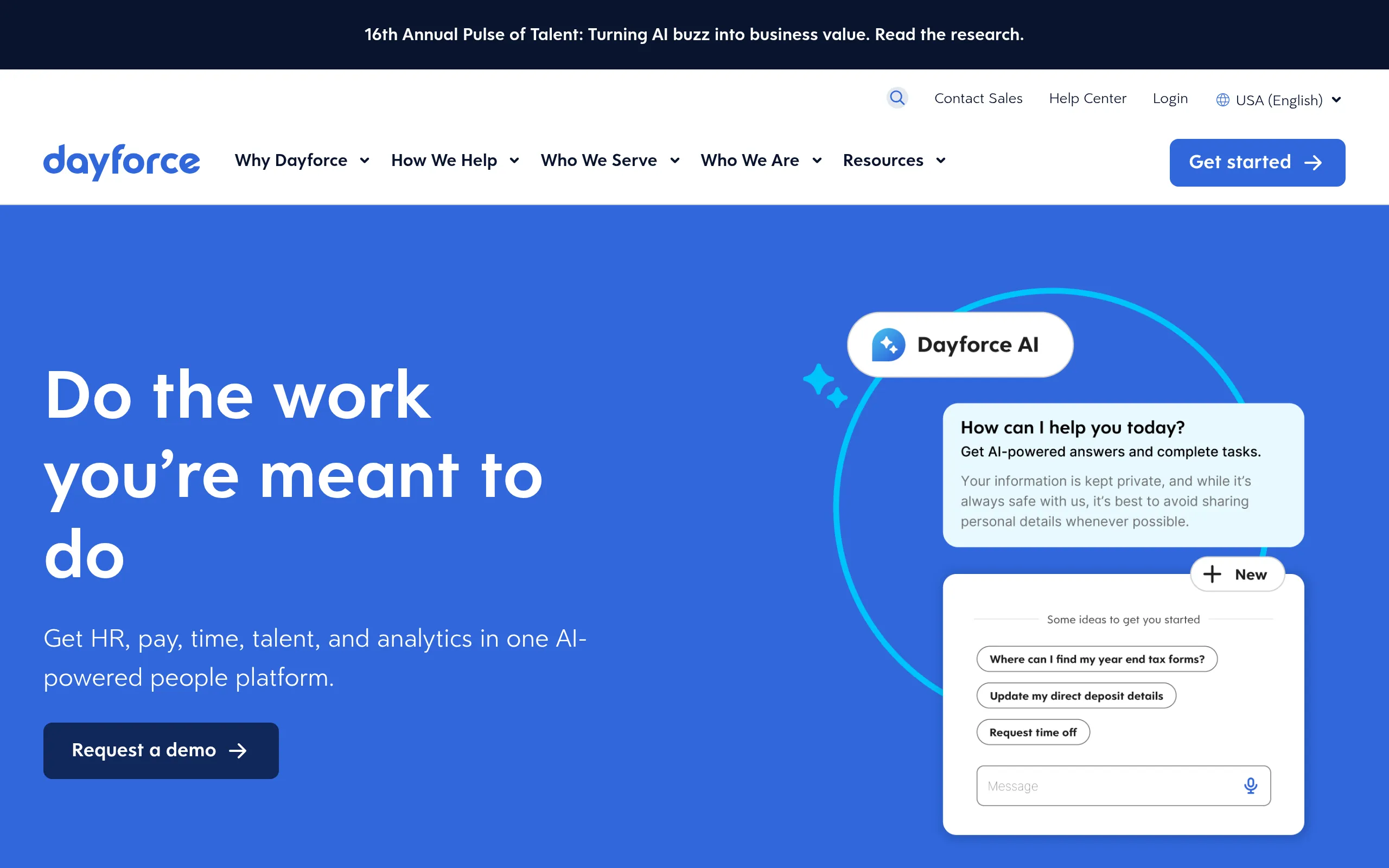
Dayforce runs HR, payroll, time, benefits, and talent on a single data model so calculations and compliance stay in sync. For U.S. startups expanding across states (and later abroad), its continuous payroll engine and integrated tax services reduce errors while partner networks extend payroll coverage globally.
-
Quick facts: Best for U.S. mid-market/enterprise teams unifying HR + payroll + time | Rating 10/10 | Pricing: By quote | Payroll: Yes | Benefits: Yes | EOR: No (partners) | Contractors: Yes | Integrations: Greenhouse, NetSuite, Okta
-
What startups will like:
-
One employee record powering HR, time, and payroll.
-
U.S. payroll with multi-state filings and real-time calculations.
-
Global payroll via partner network; optional managed services.
-
Configurable onboarding/offboarding and policy workflows.
-
Documents, PTO/leave, approvals, and mobile self-service.
-
Integration Studio and marketplace apps (ATS/accounting/SSO).
-
-
Pros: Unified platform reduces reconciliation; strong U.S. payroll/tax; broad partner network; on-demand pay with Dayforce Wallet.
-
Cons: No native EOR; implementations can be lengthy; pricing by quote.
7. ADP Workforce Now
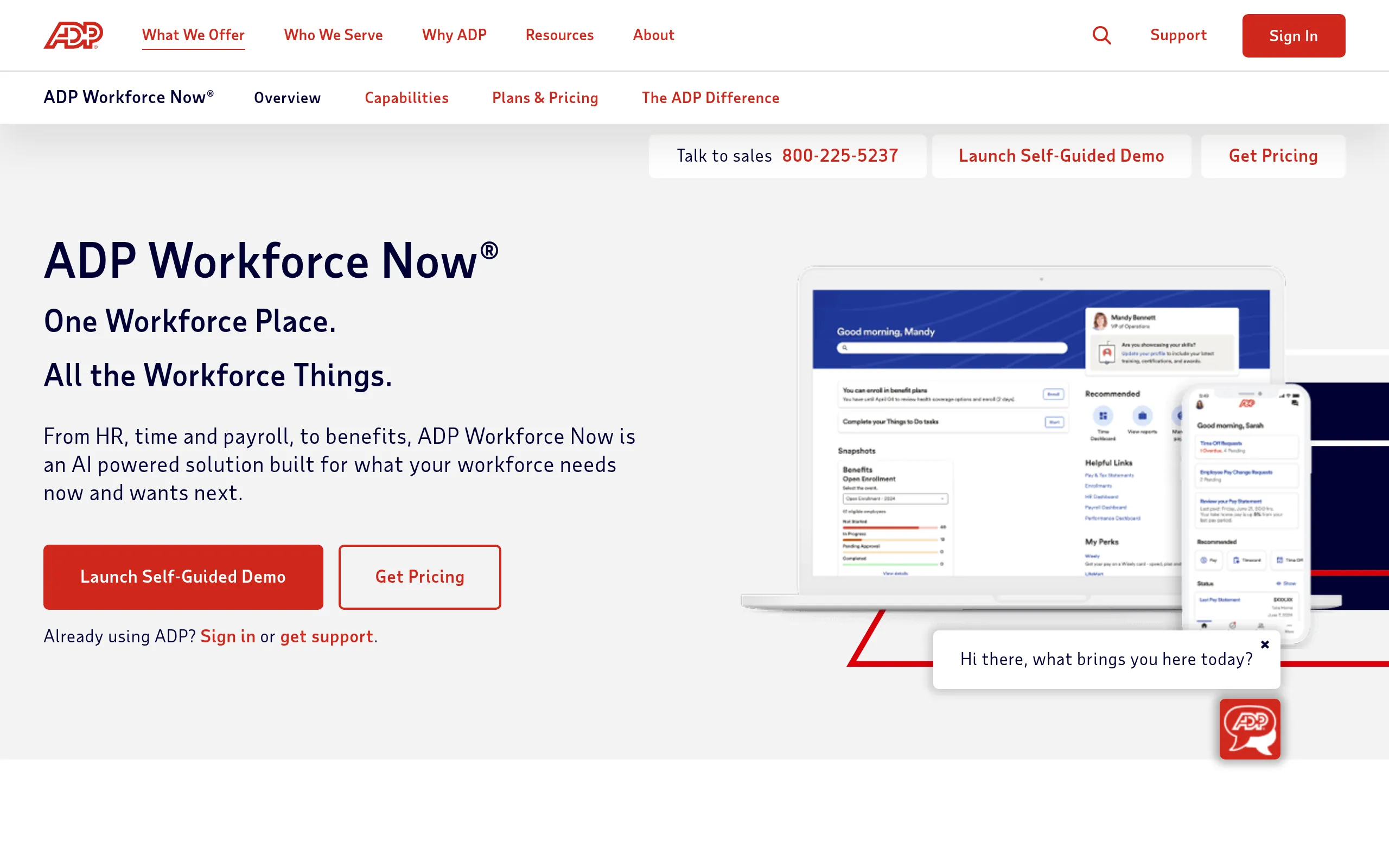
ADP Workforce Now is a mid-market workhorse: HRIS, payroll, time, benefits, and talent with the compliance depth ADP is known for. As your footprint expands, you can add Celergo/GlobalView for multi-country payroll, WorkMarket for contractors, and marketplace EOR partners, keeping one core system as the anchor.
-
Quick facts: Best for North American firms needing HRIS + payroll with global extensions | Rating 10/10 | Pricing: Quote PEPM + base | Payroll: Yes | Benefits: Yes | EOR: Yes (via partners ~180 countries) | Contractors: Yes (WorkMarket) | Integrations: ATS/ERP/SSO
-
What startups will like:
-
Core HRIS with electronic I-9 and multi-language fields.
-
U.S./Canada payroll with automated filings and year-end (W-2/1099).
-
Add Celergo/GlobalView for consolidated global payroll reporting.
-
EOR via marketplace partners for fast, entity-less hiring.
-
Contractor lifecycle in WorkMarket: onboarding, dispatch, and pay.
-
DataCloud analytics plus broad ATS/ERP/SSO integrations.
-
-
Pros: Proven payroll/compliance; scalable to global operations; vast ecosystem; reliable support and benchmarks.
-
Cons: Pricing by quote and add-ons; EOR is partner-led; implementations can be heavier.
8. Rippling
Rippling is a modern HRIS that also automates IT provisioning, giving startups one command center for people, payroll, devices, and access. It stands out for fast implementation, strong multi-state payroll automation, and a global model that supports EOR and contractor pay, backed by a large integration marketplace.
-
Quick facts: Best for startups unifying HR + payroll + IT with global hiring | Rating 4.8/5 | Pricing: $8 PEPM + base | Payroll: Yes | Benefits: Yes | EOR: Yes (~80 countries) | Contractors: Yes | Integrations: ATS, accounting, SSO (650+)
-
What startups will like:
-
Global HRIS with localized fields and multicurrency reporting.
-
U.S. payroll: automated state registrations, filings, W-2/1099.
-
Global hiring: EOR plus contractor pay in 185+ countries.
-
On/Offboarding that also provisions apps/devices.
-
Time off, e-signature, workflow approvals, and dashboards.
-
APIs and a broad marketplace across ATS/accounting/SSO.
-
-
Pros: All-in-one stack; speedy workflows; excellent multi-state automation; huge ecosystem; access to global HR advisors.
-
Cons: Pricing and some capabilities are add-on; coverage varies by country; selective native global payroll.
9. Paylocity
Paylocity is a U.S.-centric HCM for SMB and mid-market teams that need dependable multi-state payroll and a modern HR suite. It centralizes HR, payroll, time, benefits, and talent, and pairs with global payroll partners so U.S. and international runs can be viewed and controlled from one system.
-
Quick facts: Best for U.S. SMB–mid-market centralizing HRIS + multi-state payroll | Rating 10/10 | Pricing: By quote | Payroll: Yes | Benefits: Yes | EOR: No (partners) | Contractors: Yes | Integrations: Greenhouse, NetSuite, Okta
-
What startups will like:
-
Core HR: employee records, secure docs, custom fields.
-
U.S. payroll: automated federal/state/local filings and year-end.
-
Global payroll aggregation via partners such as Blue Marble.
-
Onboarding/offboarding with e-sign and policy tracking; background checks.
-
PTO accruals, mobile self-service, and pay/tax document access.
-
Analytics dashboards; connectors for ATS, accounting, and SSO.
-
-
Pros: Strong U.S. payroll automation; broad HR suite; solid integrations and SSO.
-
Cons: No native EOR; global payroll is aggregator-style; pricing and add-ons vary by configuration.
10. Paycom
Paycom delivers a single-database HCM where HR, payroll, time, and talent live together, minimizing data re-entry and reconciliation. Its employee-driven Beti payroll moves error correction upstream before payday, which can be a game-changer for lean HR teams running complex multi-state cycles.
-
Quick facts: Best for U.S. SMB/mid-market needing a single-database HRIS | Rating 10/10 | Pricing: By quote | Payroll: Yes | Benefits: Yes | EOR: No | Contractors: Yes | Integrations: ATS, accounting, SSO
-
What startups will like:
-
One employee record with self-service, docs, I-9/E-Verify.
-
U.S. payroll with Beti and multi-state tax filings.
-
Native payroll in U.S., Canada, Mexico, U.K., Ireland; global HCM layer for others.
-
Onboarding/offboarding checklists and e-signatures.
-
Time tracking, scheduling, PTO; GL exports and reporting.
-
SAML-based SSO and common HR/finance integrations.
-
-
Pros: Single database; Beti reduces payroll errors; strong U.S. compliance; dedicated support model.
-
Cons: No EOR; limited native international payroll; fewer third-party integrations; pricing by quote.
11. Paycor
Paycor is a cloud HR and payroll platform for SMBs and mid-market employers that bundles core HR, U.S. payroll, time, benefits, and recruiting. It’s built for teams that want pragmatic automation, especially onboarding and workflows, plus a path to global hiring through marketplace EOR partners.
-
Quick facts: Best for U.S. SMBs consolidating HRIS + payroll + recruiting | Rating 10/10 | Pricing: From $99/mo + $5 PEPM (tiers vary) | Payroll: Yes | Benefits: Yes | EOR: No (partners) | Contractors: Yes | Integrations: ATS, QuickBooks/NetSuite, SSO
-
What startups will like:
-
Core HR records with org charts, docs, and configurable workflows.
-
U.S. payroll with multi-state filings and ACA reporting.
-
Global hiring via partner EOR providers that sync back to HRIS.
-
Onboarding/offboarding with templates and e-signatures.
-
PTO tracking, benefits enrollment, workers’ comp tools.
-
Visier-powered analytics; integrations with Greenhouse, Intacct, Okta/Entra.
-
-
Pros: All-in-one suite including ATS; embedded analytics; broad marketplace integrations; SMB-friendly packaging.
-
Cons: No native EOR; some connectors require middleware; support/API depth can vary by tier; mid-market pricing is quoted.
12. BambooHR
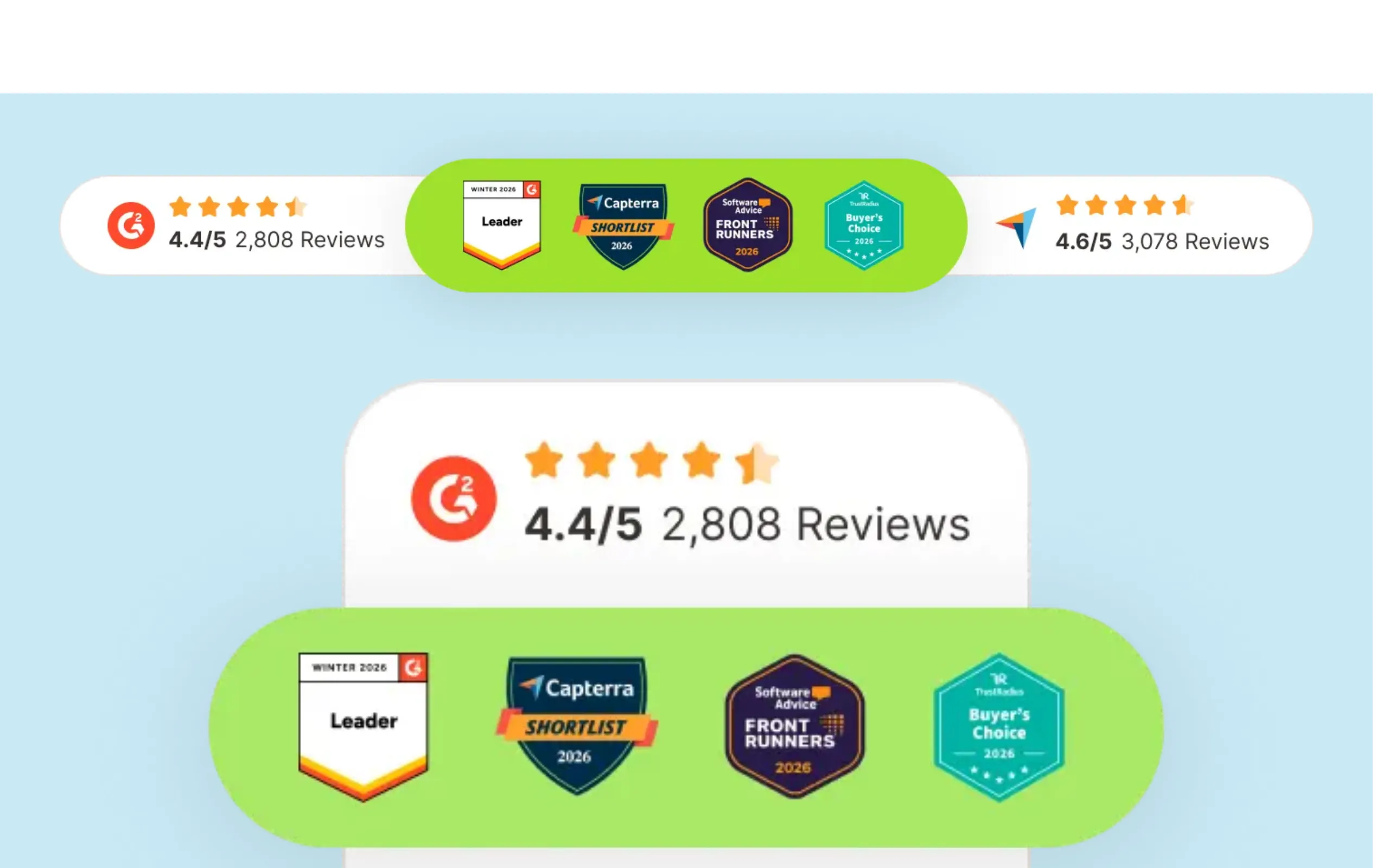
BambooHR is a popular SMB HRIS that folds in an ATS, U.S. payroll, benefits administration, and partner-powered global hiring, giving startups a simple, affordable way to centralize people operations. Month-to-month flexibility and straightforward workflows make it easy to get value fast.
-
Quick facts: Best for SMBs consolidating HRIS + ATS + payroll/benefits + EOR | Rating 10/10 | Pricing: From ~$250/mo for ≤25 | Payroll: Yes | Benefits: Yes | EOR: Yes (~90, via partner) | Contractors: Yes | Integrations: ATS, accounting, SSO
-
What startups will like:
-
Core HR/records with e-signatures and centralized files.
-
U.S. payroll with multi-state tax filings and W-2/1099.
-
EOR through a partner (e.g., Remote) plus contractor support.
-
Onboarding/offboarding checklists and policy tracking.
-
PTO/time tracking with a clear Who’s Out calendar.
-
150+ integrations including QuickBooks/Xero/NetSuite and SSO.
-
-
Pros: Fast SMB onboarding; consolidated HR/ATS/payroll/benefits; embedded EOR option; rich marketplace.
-
Cons: EOR and non-U.S. payroll via partners; U.S. benefits-centric; contractor payments may rely on integrations.
13. Personio
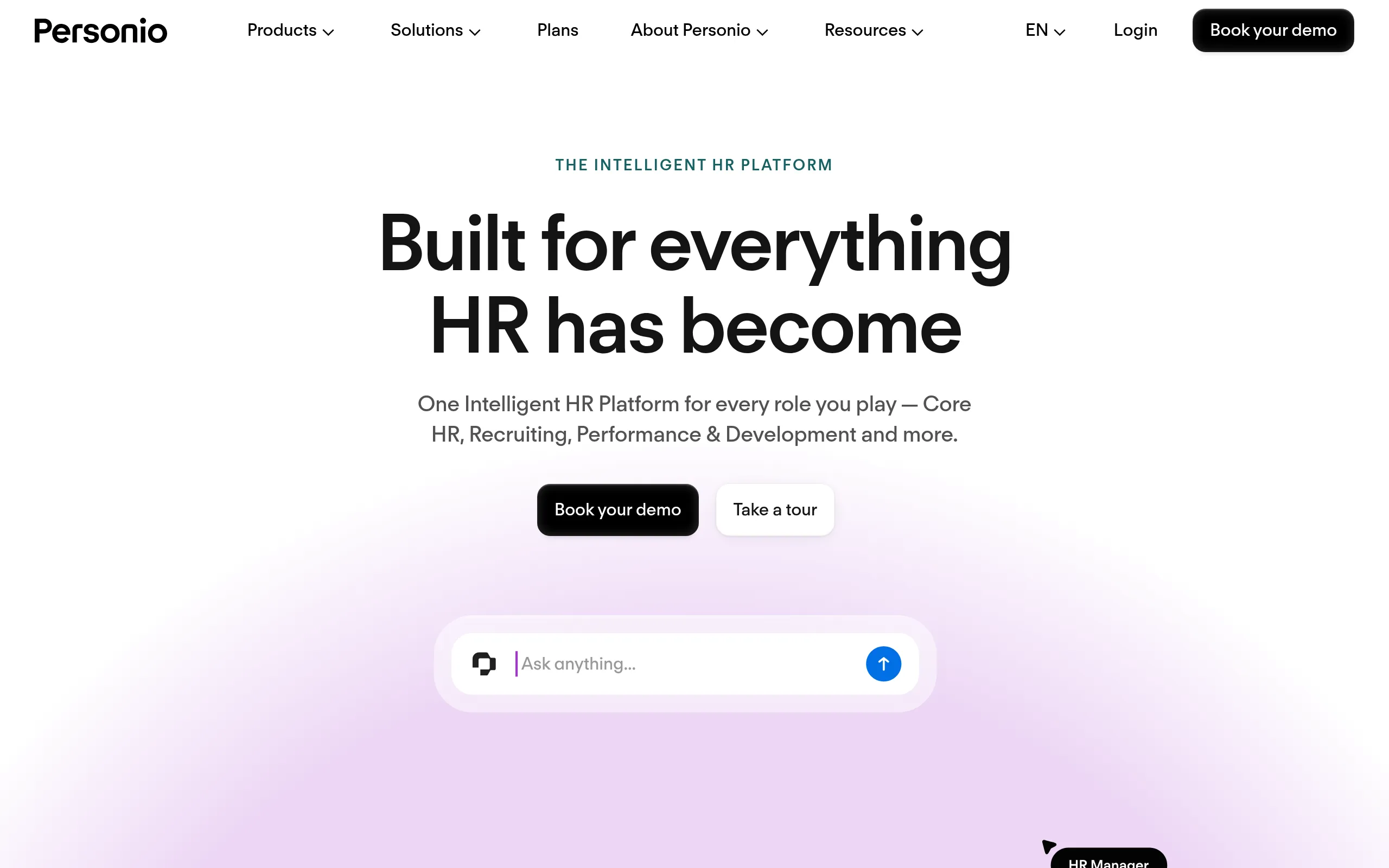
Personio is a European-born HR platform tailored to SMB and mid-market organizations, making it a natural fit for U.S. startups with growing EU teams. It unifies core HR, recruiting, time/absence, documents, and analytics, with native German payroll and partner-powered EOR for rapid hiring across borders.
-
Quick facts: Best for U.S. startups with EU teams | Rating 10/10 | Pricing: By quote | Payroll: Yes (DE; others via partners) | Benefits: Via integrations | EOR: Yes (via partners ~90–100 countries) | Contractors: Basic | Integrations: Greenhouse, Xero, Okta
-
What startups will like:
-
Multi-entity, multi-language core HR with e-signatures and org charts.
-
German payroll natively; UK/EU payroll via integrations (e.g., DATEV/Xero).
-
EOR through partners (e.g., Remote) for entity-less hiring.
-
Automated onboarding/offboarding with SSO/IAM triggers.
-
Time off and attendance with policy controls; concise analytics.
-
Integrations for ATS/accounting and SSO (Okta/Entra).
-
-
Pros: Strong EU footprint; native DE payroll; partner EOR; SSO/IAM automation; built for multi-entity/language operations.
-
Cons: No native U.S. payroll; partner-led EOR; contractor management is basic; pricing by quote.
14. Namely
Namely targets mid-market companies that want one place for HR, U.S. payroll, time, benefits, and compliance without the heavy lift of enterprise systems. A dedicated Service Pod and 24/7 help make it approachable, while partner networks extend into global payroll, contractors, and EOR when you need it.
-
Quick facts: Best for firms with 50–2,500 employees consolidating HR + U.S. payroll | Rating 10/10 | Pricing: From ~$9 PEPM (tiers vary) | Payroll: Yes | Benefits: Yes | EOR: Partner-led (~185+ countries) | Contractors: Yes | Integrations: Greenhouse, NetSuite, Okta
-
What startups will like:
-
Core HR with e-signatures, workflows, and approvals.
-
U.S. payroll with multi-state filings and W-2/1099; Managed Payroll optional.
-
Global extensions via partners for EOR, payroll, and contractors.
-
Onboarding/offboarding with I-9, templates, and tasking.
-
Time off tracking, compliance alerts, dashboards, and API.
-
Integrations to ATS/accounting and SSO.
-
-
Pros: All-in-one HRIS + U.S. payroll; hands-on support model; fast implementations on entry tier.
-
Cons: No native EOR/global payroll; pricing can vary with add-ons; accounting integrations thinner beyond NetSuite.
15. HiBob
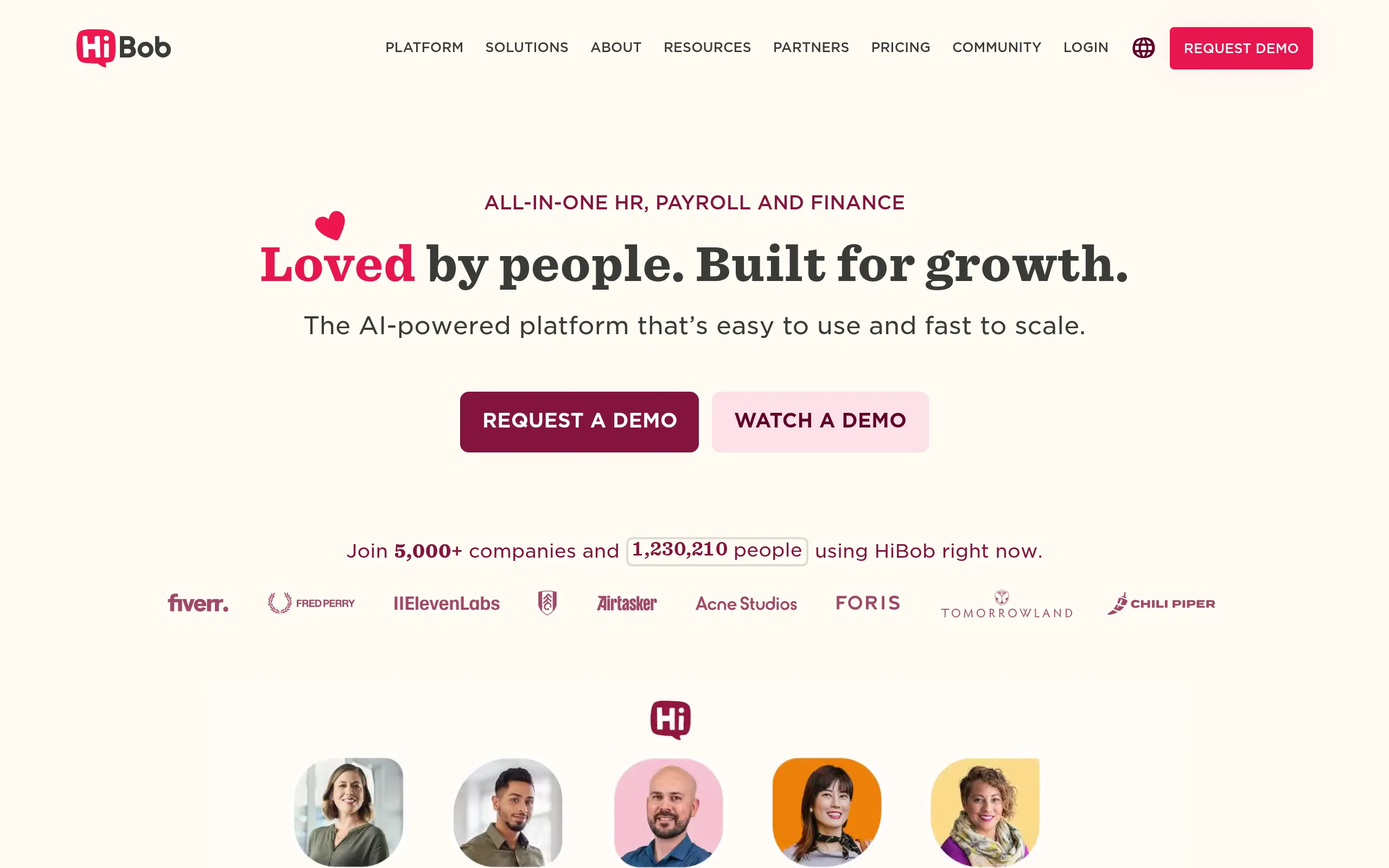
HiBob (bob) is a modern HRIS for fast-growing, distributed companies that want polished core HR with payroll options and a deep integration marketplace. For U.S. teams, it offers embedded U.S. payroll with 50-state filings and HMRC-compliant payroll in the U.K., plus one-click connectors to leading EOR partners for global hiring.
-
Quick facts: Best for mid-market startups combining HRIS + US/UK payroll | Rating 10/10 | Pricing: By quote (typ. ~$16–$25 PEPM) | Payroll: Yes (US/UK) | Benefits: Yes | EOR: No (partners ~150–187+) | Contractors: Yes | Integrations: Greenhouse, NetSuite, Google/Okta
-
What startups will like:
-
Global core HR: records, org charts, e-sign, time/attendance, analytics.
-
U.S. payroll with multi-state filings and 1099 support.
-
U.K. payroll that’s HMRC-compliant, including year-end processes.
-
EOR connectors to G-P, Deel, Remote, Oyster for fast global hiring.
-
Smooth on/offboarding with Google/Okta/Entra provisioning.
-
Payroll Hub and benefits connectors (bswift, Sequoia, PlanSource).
-
-
Pros: Consolidates HR with US/UK payroll and U.S. benefits; compliance depth; robust ecosystem; quick go-lives.
-
Cons: No first-party EOR; native payroll limited to US/UK; pricing not public; diligence recommended on U.S. payroll specifics.
From shortlist to decision demos pilots and reference checks
Make the last mile of your hris vendor comparison count.
Structured demos
-
Use real employee data templates with realistic edge cases
-
Ask the vendor to walk through three scenarios you will run weekly
-
Confirm how they handle corrections, late hires, and retro pay
Hands on pilots
-
Run a short pilot with a subset of employees
-
Measure time saved, error rates, and support responsiveness
-
Require a written implementation plan with dates, accountable owners, and training paths
Reference checks
-
Talk to two customers of similar size in similar states or with similar global needs
-
Ask what went well, what needed work, and what they would do differently
Commercial clarity
-
Lock renewal caps and module pricing for two years
-
Get SLAs for payroll timing, ticket response, and data export reliability
If your shortlist includes a single vendor that unifies recruiting, global hiring, and payroll, you can schedule a fast walk through with Bolto.
Conclusion
A modern hris vendor comparison should help you decide faster and de risk the rollout. Focus on security, compliance, and the workflows your team runs every week. Validate features with scenario based demos, run a small pilot, and talk to references that look like you. Bring finance and IT into the decision early so integrations and controls are set up right, then invest in training to realize the value you paid for.
Curious how an all in one stack can simplify your toolset
Take a quick look at Bolto and see how recruiting, payroll, and global HR come together.
FAQs
What is an HRIS and how does it differ from HCM
HRIS usually refers to core employee records, payroll, time, and basic workflows. HCM often adds talent modules like performance and learning. The exact labels vary by vendor, which is why a clear hris vendor comparison is useful.
How long does HRIS implementation take
Small to midsize companies often complete implementation in 4 to 14 weeks, while broader projects with more modules and integrations can take 3 to 6 months. (bamboohr.com)
Which regulations most affect HRIS selection in 2025
Pay transparency rules in 14 states plus DC, paid family and medical leave programs in 13 states plus DC, and multi state payroll tax rules all drive configuration needs. (paylocity.com)
How do I compare HRIS security
Ask for SOC reports, SSO and MFA, granular permissions, and audit logs. Rising breach costs make these table stakes in any hris vendor comparison. (ibm.com)
What hidden costs should I model beyond software list price
Implementation, data migration, training, integration work, support tiers, and risk of penalties for late deposits or multi state missteps. IRS deposit penalties can reach 15 percent. (irs.gov)
Can one vendor cover US payroll, contractors, and global hiring
Yes, several platforms now combine these in one system. If you want to evaluate a unified approach during your hris vendor comparison, try a demo with Bolto.
How should I run vendor demos
Use a written script that mirrors your real processes, require the vendor to show corrections and exceptions, and score results with a weighted model that reflects your priorities.
How many HR staff do we really need
A common benchmark is about 1.4 HR staff per 100 employees, though smaller companies often need more due to fixed workload. Automation in your chosen HRIS can help lean teams do more with less. (moreton.com)