

Best Multi Country Payroll Software Solutions in June 2026

Hiring globally is faster than ever, but paying those employees correctly across borders is still a mess for most companies. You're either managing separate payroll runs in every country, each with its own vendor and compliance rules, or you're using international payroll software that still requires manual tax filings and constant reconciliation. When researching multi country payroll solutions, whether that's adp global payroll, adp globalview login systems, papaya global, or other top global payroll providers, what you actually need is one platform that handles local tax calculations, statutory benefits, and payslip delivery without your team becoming compliance experts in 150 jurisdictions. This guide ranks the best global payroll providers for 2026, including the top 10 global payroll providers in usa and worldwide, multi country payroll software with real automation, adp celergo vs globalview comparisons, multi country payroll services that scale, and insights from gartner payroll magic quadrant 2024 and discussions on the best global payroll providers reddit threads.
TLDR:
- Pay employees in 150+ countries from one system that automates local tax calculations, statutory deductions, and compliance filings without manual tracking.
- Cut payroll admin time by 8 hours per week with AI compliance automation that delivers 99.8% accuracy across all jurisdictions.
- Onboard global hires in 48 hours instead of waiting 3+ months for entity setup and vendor contracts.
- Reduce global payroll costs by up to 70% by replacing fragmented country-by-country vendor relationships with one unified system.
- Compare providers by setup speed, compliance depth, and whether recruiting, payroll, and HR connect in one view or require separate logins.
Best Multi Country Payroll Software Solutions in June 2026
Managing payroll across multiple countries is one of the harder business challenges for global teams. Tax rules shift constantly across borders. Compliance requirements vary by country, and the cost of getting it wrong ranges from penalties to full reclassification risk. Piecing together separate tools for each market only adds to the burden.
This list covers the best multi-country payroll software in 2026, ranked by global coverage, accuracy, compliance depth, and overall value for the money. Whether you're paying a few contractors across borders or running full-cycle payroll for hundreds of employees worldwide, the right software matters.
What is Multi Country Payroll Software?
Multi country payroll software lets you pay employees and contractors across multiple countries from a single system, handling local tax calculations, statutory deductions, and compliance filings in each jurisdiction automatically.
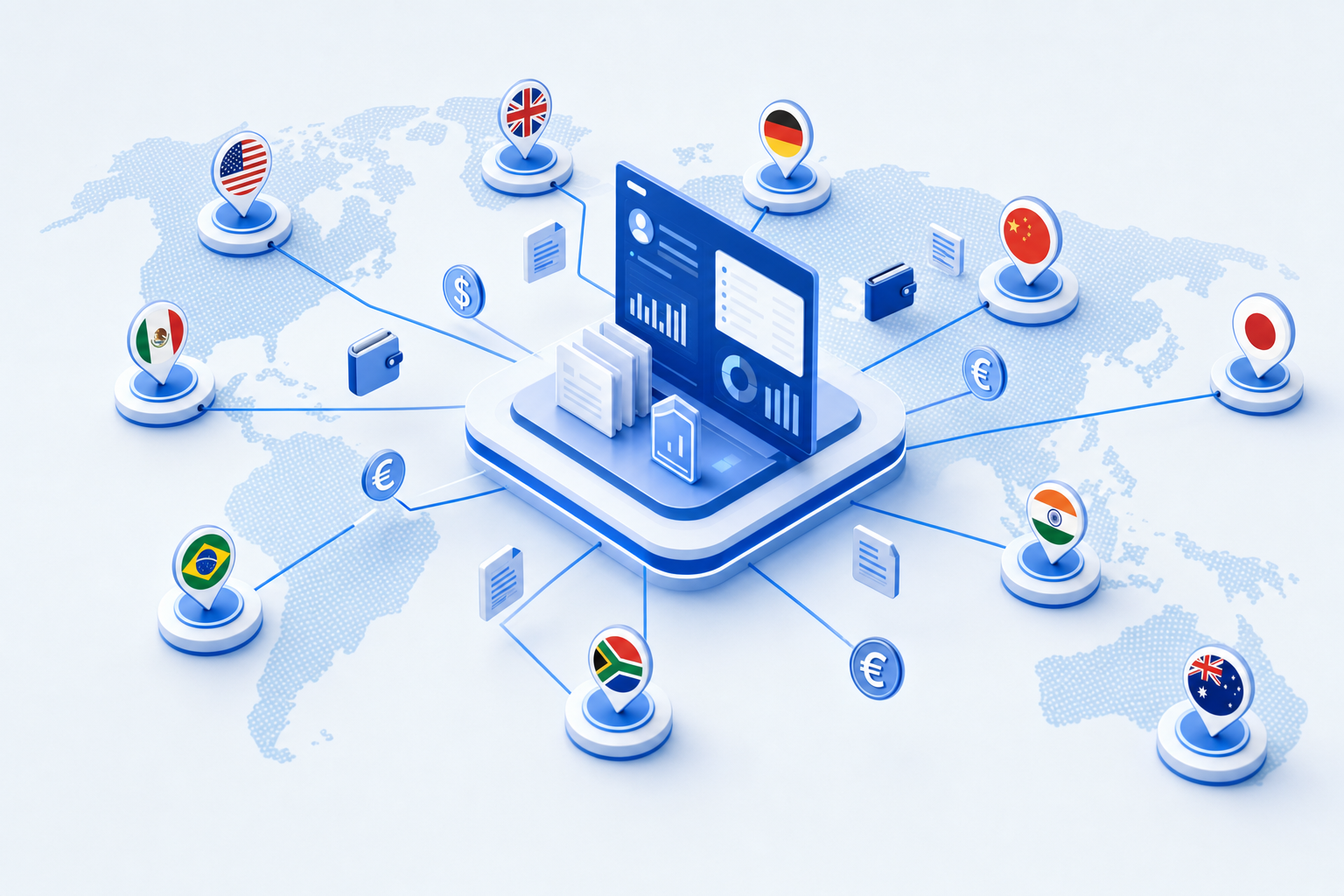
If your team spans borders, the alternative is managing a separate payroll process in every country you operate in. That means different vendors, different deadlines, different compliance rules, and a growing risk of errors as you scale.
Here's what a capable multi country payroll solution handles:
- Local tax calculations and filings in each country your employees are based in, so you're not manually tracking rate changes or filing deadlines across jurisdictions.
- Currency conversion and multi-currency payouts, letting you pay employees in their local currency without running separate banking processes for each country.
- Compliance with country-specific labor laws and tax withholding, including statutory benefits, mandatory contributions, and payslip requirements that vary widely from one country to the next.
- Centralized reporting across all countries, giving finance and HR teams a single view of global payroll costs instead of piecing together data from multiple sources.
The core promise is replacing fragmented, country-by-country payroll operations with one system that scales as you hire globally.
How We Ranked Multi Country Payroll Software
We compared each provider against a consistent set of criteria drawn from real buyer priorities in 2026, covering top global payroll solutions. Coverage depth matters: a vendor that supports payroll in 15 countries serves a different buyer than one covering 150. We also looked at compliance automation, how well each tool handles local tax filings and statutory reporting without manual intervention. Integration flexibility, implementation timelines, and transparent pricing were weighted heavily. Finally, we factored in third-party reviews from sources like G2, Capterra, and Gartner to give you a grounded picture of how each provider performs in practice.
Best Overall Multi Country Payroll Software: Bolto
Bolto is built for companies that need to pay people in multiple countries without stitching together a patchwork of local vendors. It brings recruiting, payroll, HR, and Employer of Record (EOR) services into one place, so your team isn't switching between five tools to get a single hire paid correctly.
Where most multi country payroll software forces you to manage country-specific configurations manually, Bolto automates compliance across 150+ countries. The result is 99.8% payroll accuracy and runs that finish up to 80% faster than traditional setups.
What Sets Bolto Apart
A few things make Bolto worth serious consideration for global teams:
- AI handles the compliance logic, so tax filings, statutory deductions, and labor laws are applied automatically without your HR team needing to become experts in every jurisdiction.
- New hires can be onboarded in as little as 48 hours, which matters when you're expanding into a new market quickly.
- Finance teams report saving around 8 hours per week on payroll-related admin, and companies typically see payroll costs drop by roughly 70% compared to managing a mix of local providers.
- Everything sits in one system. Recruiting, contracts, payroll, and HR records are connected, so you're not reconciling data across separate tools at month-end.
Bolto is a strong fit if your headcount spans multiple countries and you want a single source of truth for your global workforce rather than a collection of country-specific workarounds.
Remote
Remote runs its own legal entities across 186 countries, covering employer of record (EOR) services, contractor management, and global payroll. That owned-entity model means one accountable party rather than a network of local partners handling compliance on your behalf.
Here's what that looks like in practice:
- Coverage in 186 countries through owned legal entities, giving you direct accountability rather than reliance on third-party partners
- Automated payroll, tax filings, and compliance handling across those markets
- API access and HRIS integrations for connecting to your existing tools
- Crypto payment options available for both contractors and employees
Good for: Companies hiring in less common markets that need owned-entity compliance accountability rather than an aggregator model.
Limitation: Implementation averages 3+ months, well above the 48-hour to 4-week timelines competitors offer, which creates real friction for teams expanding quickly.
Bottom line: Remote delivers the broadest owned-entity coverage in the category. The three-month setup window, though, makes it a poor fit if speed matters.
Papaya Global
Papaya Global is a cloud-based multi-country payroll and workforce management solution built for companies managing employees and contractors across multiple countries. It positions itself as a single system for consolidating global payroll data, compliance, and payments.
What Papaya Global Does Well
- The software aggregates payroll from multiple in-country partners into one dashboard, giving HR and finance teams visibility across regions without logging into separate systems.
- It supports contractor and employer of record (EOR) arrangements alongside owned-entity payroll, so companies with mixed workforce types can manage everyone in one place.
- Papaya Global has built-in compliance monitoring that tracks regulatory changes across supported countries, which reduces the manual research burden on HR teams.
Where Papaya Global Falls Short
- Pricing is typically built around per-employee-per-month models that scale quickly, making it expensive for companies with large international headcounts.
- Users on review sites frequently cite implementation timelines and customer support responsiveness as pain points, particularly during initial setup across multiple countries.
- The system relies heavily on a network of local in-country partners, which can introduce inconsistencies in payroll accuracy and service quality depending on the country.
Who It's Best For
Papaya Global suits mid-to-large enterprises that need consolidated visibility across many payroll jurisdictions and have dedicated HR operations teams to manage the setup and ongoing relationship. It is less suited to fast-scaling companies that need quick onboarding and predictable support.
Multiplier
Multiplier covers Employer of Record (EOR), contractor management, and global payroll across 150+ countries, with a developer-friendly interface designed for companies hiring internationally without local entities.
Here is a quick look at what they offer:
- Multi-country payroll with automated calculations and deductions
- Localized employment contracts generated in minutes. Labor law compliance updates automatically
- Payroll in over 120 local currencies with USD conversion for review
- Cryptocurrency payment capability for contractors and employees
Good for: Startups and mid-sized companies expanding into Asia-Pacific markets that want transparent pricing for standard-complexity countries, at around $400 per employee per month.
Limitation: The global payroll product for companies with existing entities is less mature than the EOR offering, and there is no payroll-only option for businesses that already have their own local entity.
Bottom line: Multiplier delivers solid EOR with genuine APAC regional depth. The gap in payroll-only coverage is a real constraint for companies with existing entities that just need compliant multi-country payroll without the EOR wrapper. Bolto handles both owned-entity payroll and EOR arrangements from day one.
Oyster
Oyster is a global employment solution aimed at remote-first companies that want to hire internationally without setting up local entities. It positions itself around Employer of Record (EOR) services, localized benefits, and payroll in multiple currencies, with coverage spanning over 180 countries.
Where Oyster stands out is in its benefits administration layer. The product offers locally benchmarked benefits packages, which can help smaller companies compete for talent in markets where statutory minimums fall short of candidate expectations.
What to Know Before Committing
A few practical considerations worth weighing:
- Pricing scales per contractor or employee, which can get expensive quickly as your international headcount grows beyond a handful of hires.
- Customer support quality tends to get mixed reviews at scale, with some HR teams reporting slower response times once volume increases.
- The product works well for straightforward EOR use cases, but companies managing complex, multi-country payroll runs with regional tax nuance may find the tooling thinner than expected.
- There is limited native recruiting functionality, so you will likely need a separate hiring tool alongside it.
Oyster suits early-stage teams making their first few international hires. If your global headcount is growing fast or your payroll requirements span many jurisdictions with varying compliance demands, you may outgrow what it offers sooner than expected.
G-P (Globalization Partners)
Globalization Partners (G-P) built the Employer of Record (EOR) category starting in 2012 and covers 180+ countries with owned-entity compliance infrastructure. Their focus is on helping companies hire internationally without setting up local legal entities.
What They Offer
- Payroll without local entities, with local tax compliance handled automatically in each country
- Locally benchmarked benefits packages, including health insurance and retirement plans
- Integrations with Workday, SAP SuccessFactors, and Greenhouse for HR data continuity
- A dedicated in-country support team to manage local employment law questions
Where They Fall Short
G-P is a strong EOR provider, but their product is built around entity-based hiring rather than a unified HR experience. Recruiting, payroll, and workforce management often require separate tools or manual handoffs, which adds friction for fast-growing teams managing multiple countries at once.
Feature Comparison Table of Multi Country Payroll Software
Side-by-side, the gaps between providers become harder to ignore. Here's how each one compares across the features buyers most commonly ask about.

| Feature | Bolto | Remote | Papaya Global | Multiplier | Oyster | G-P |
|---|---|---|---|---|---|---|
| Countries Supported | 150+ | 186 | 160+ | 150+ | 180+ | 180+ |
| Payroll Accuracy Rate | 99.8% | Not disclosed | Not disclosed | Not disclosed | 99%+ | Not disclosed |
| Setup Time | 48 hours | 3+ months | Not disclosed | Not disclosed | Days to weeks | Not disclosed |
| Contractor Payments | Yes | Yes | Yes | Yes | Yes | Yes |
| EOR Services | Yes | Yes | Yes | Yes | Yes | Yes |
| Native QuickBooks Integration | Yes | No | No | No | Yes | No |
| Unified Recruiting & Payroll | Yes | No | No | No | No | No |
| AI Compliance Monitoring | Yes | No | No | No | No | Yes (add-on) |
| Transparent Pricing | Yes | No | No | Yes | Yes | No |
Most providers cover the basics: EOR, contractor payments, and broad country support. The sharper differences show up in setup speed, compliance automation, and whether payroll integrates with the rest of your hiring workflow.
Why Bolto is the Best Multi Country Payroll Software
Bolto brings together recruiting, payroll, HR, and Employer of Record (EOR) services into one connected system, so you stop stitching together separate tools for each country you hire in.
Here's what sets it apart for multi country payroll specifically:
- Payroll runs across 150+ countries with 99.8% accuracy, so your team members get paid correctly the first time regardless of where they live.
- AI handles tax calculations, deductions, and compliance checks automatically, cutting manual work by roughly 8 hours per week.
- Setup takes as little as 48 hours, compared to months of entity setup through traditional approaches.
- Costs run up to 70% less than legacy global payroll suites, without sacrificing country coverage or compliance depth.
- A single login gives you payslips, headcount data, and compliance status across every country in one view.
For HR and finance leaders managing teams across multiple jurisdictions, the consolidated approach means fewer vendor contracts, fewer reconciliation headaches, and a single source of truth for every pay run.
FAQ
How do I choose the right multi country payroll software for my business?
Start by mapping where your team members are located and whether you need full payroll, contractor payments, or employer of record services in each country. Then compare setup timelines, compliance automation depth, and whether the tool integrates with your existing HR and accounting stack. If you're scaling quickly across multiple regions, choose systems that consolidate payroll, recruiting, and HR in one system instead of requiring separate tools per country.
Which multi country payroll solution works best for companies without local entities?
Systems offering employer of record (EOR) services let you hire and pay employees in countries where you don't have a legal entity, with the EOR acting as the legal employer while you manage day-to-day work. Bolto, Remote, and G-P all provide owned-entity EOR coverage across 100+ countries. The key differences are setup speed (Bolto completes onboarding in 48 hours versus Remote's three-month average) and whether payroll, recruiting, and HR are unified or require multiple logins.
What's the difference between multi country payroll software and a global EOR provider?
Multi country payroll software handles tax calculations, filings, and payments for employees in countries where you already have a legal entity. A global EOR provider becomes the legal employer on paper in countries where you don't have an entity, handling contracts, statutory benefits, and compliance on your behalf. Some systems, including Bolto, offer both: direct payroll for owned entities and EOR services for new markets, so you can manage both workforce types from one system.
Can I use the same system to pay both employees and contractors internationally?
Yes. Most modern multi country payroll systems support contractor payments alongside employee payroll, though the processing rails differ (contractors receive payments via invoicing instead of payroll runs). Bolto, Multiplier, and Oyster all handle both worker types in one dashboard, with automated tax documentation (W-2s for US employees, 1099s for US contractors, and country-specific equivalents internationally) and multi-currency payouts included.
How long does it take to set up multi country payroll software?
Setup timelines range from 48 hours to over three months depending on the provider and your existing entity structure. Bolto completes onboarding in as little as 48 hours for companies with straightforward setups. Remote averages three months. Papaya Global and G-P fall somewhere in between but don't publicly disclose specific timelines. If speed matters because you're expanding into new markets quickly or have hiring deadlines, confirm the provider's actual implementation window before committing.
Final Thoughts on Selecting Multi Country Payroll Software
Global payroll gets complicated fast when you're managing separate systems for every country. The difference between a fragmented setup and a unified one shows up in your finance team's workload, your compliance risk, and how quickly you can hire in new markets. Finding software that handles recruiting, payroll, and compliance in one place cuts out most of that friction. Talk to Bolto if you want to see how the consolidated approach works for teams hiring across borders.
FAQ
How do I choose the right multi country payroll software for my business?
Start by mapping where your team members are located and whether you need full payroll, contractor payments, or employer of record services in each country. Then compare setup timelines, compliance automation depth, and whether the tool integrates with your existing HR and accounting stack. If you're scaling quickly across multiple regions, choose platforms that consolidate payroll, recruiting, and HR in one system instead of requiring separate tools per country.
Which multi country payroll solution works best for companies without local entities?
Platforms offering employer of record (EOR) services let you hire and pay employees in countries where you don't have a legal entity, with the EOR acting as the legal employer while you manage day-to-day work. Bolto, Remote, and G-P all provide owned-entity EOR coverage across 100+ countries. The key differences are setup speed (Bolto completes onboarding in 48 hours versus Remote's three-month average) and whether payroll, recruiting, and HR are unified or require multiple logins.
What's the difference between multi country payroll software and a global EOR provider?
Multi country payroll software handles tax calculations, filings, and payments for employees in countries where you already have a legal entity. A global EOR provider becomes the legal employer on paper in countries where you don't have an entity, handling contracts, statutory benefits, and compliance on your behalf. Some systems, including Bolto, offer both: direct payroll for owned entities and EOR services for new markets, so you can manage both workforce types from one system.
Can I use the same platform to pay both employees and contractors internationally?
Yes. Most modern multi country payroll platforms support contractor payments alongside employee payroll, though the processing rails differ (contractors typically receive payments via invoicing rather than payroll runs). Bolto, Multiplier, and Oyster all handle both worker types in one dashboard, with automated tax documentation (W-2s for US employees, 1099s for US contractors, and country-specific equivalents internationally) and multi-currency payouts included.
How long does it typically take to set up multi country payroll software?
Setup timelines range from 48 hours to over three months depending on the provider and your existing entity structure. Bolto completes onboarding in as little as 48 hours for companies with straightforward setups. Remote averages three months. Papaya Global and G-P fall somewhere in between but don't publicly disclose specific timelines. If speed matters because you're expanding into new markets quickly or have hiring deadlines, confirm the provider's actual implementation window before committing.