'%3e%3cpath%20id='Vector'%20d='M11.474%207.12258C11.5964%207.0054%2011.6667%206.84133%2011.6667%206.66946C11.6667%206.49758%2011.5964%206.33613%2011.474%206.21633L6.89063%201.84133C6.64063%201.60175%206.24479%201.61217%206.00781%201.86217C5.77083%202.11217%205.77865%202.508%206.02865%202.74498L9.48177%206.04446H0.625C0.278646%206.04446%200%206.3231%200%206.66946C0%207.01581%200.278646%207.29446%200.625%207.29446H9.48177L6.02604%2010.5913C5.77604%2010.8309%205.76823%2011.2241%206.00521%2011.4741C6.24219%2011.7241%206.63802%2011.732%206.88802%2011.495L11.4714%207.11998L11.474%207.12258Z'%20fill='%23FCFCFC'/%3e%3c/g%3e%3cdefs%3e%3cclipPath%20id='clip0_0_36'%3e%3crect%20width='11.6667'%20height='13.3333'%20fill='white'/%3e%3c/clipPath%3e%3c/defs%3e%3c/svg%3e)


'%3e%3cpath%20id='Vector'%20d='M31.999%2031.9996H0V0H31.999V31.9996Z'%20fill='%23FF6600'/%3e%3cpath%20id='Vector_2'%20d='M9.26953%207.85547H11.7751L14.9995%2014.3543C15.4707%2015.3217%2015.8677%2016.2643%2015.8677%2016.2643C15.8677%2016.2643%2016.2896%2015.3466%2016.7854%2014.3543L20.0599%207.85547H22.3916L16.8597%2018.249V24.8719H14.7517V18.1249L9.26953%207.85547Z'%20fill='white'/%3e%3c/g%3e%3c/g%3e%3cdefs%3e%3cclipPath%20id='clip0_0_7'%3e%3crect%20width='32'%20height='32'%20rx='5'%20fill='white'/%3e%3c/clipPath%3e%3c/defs%3e%3c/svg%3e)




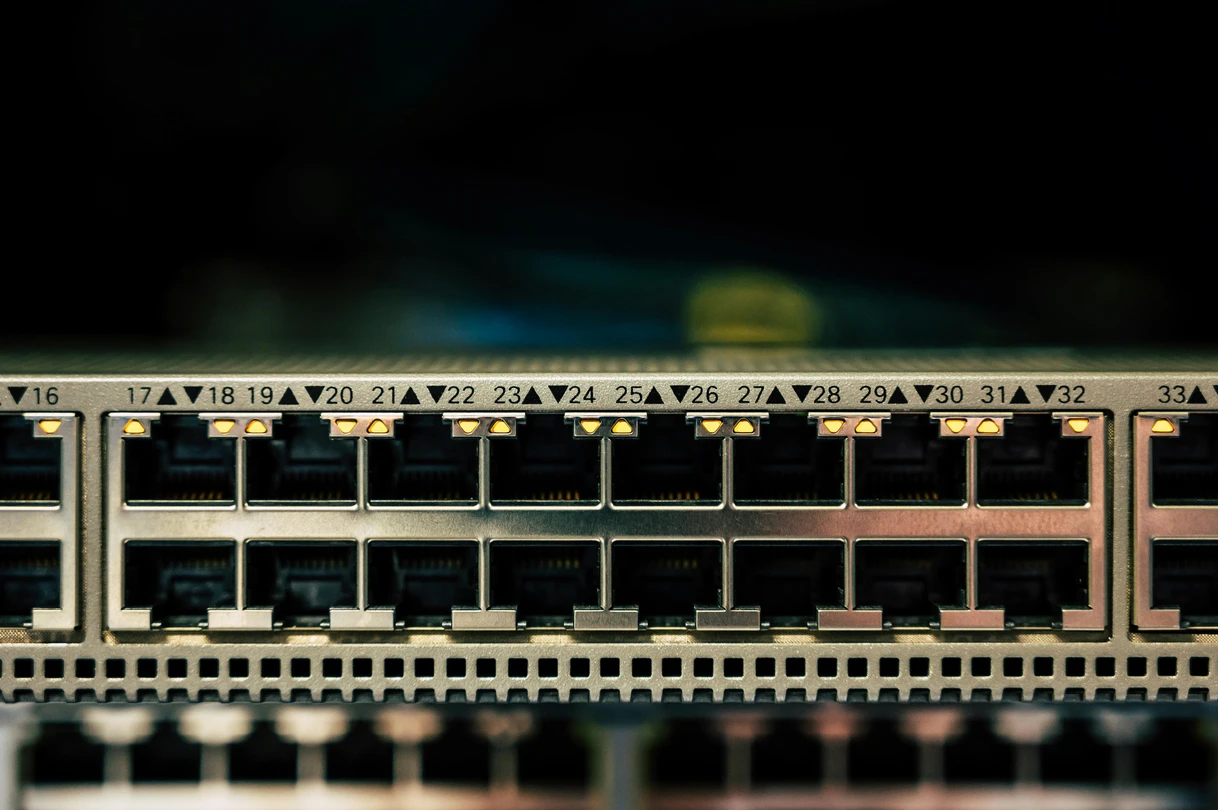
In the world of data center design, efficiency is everything. How you connect servers can greatly impact performance, cost, and management. One key architectural choice is using an eor switch, a network switch placed at the end of a server rack row to provide a central connection point for all the equipment in that row.
This design philosophy consolidates networking hardware. In this guide, we’ll break down exactly what that means, exploring the pros and cons of an eor switch compared to other designs.
(A quick note on acronyms: in networking, EoR means End of Row. In global business, EOR often stands for Employer of Record, a service for hiring international talent. If you’re looking to simplify global hiring and payroll, a platform like Bolto can act as your EOR. This article, however, is all about the networking switch.)
What Is an EoR Switch and Its Architecture?
An eor switch is a network switch placed at the end of a row of server racks in a data center. Instead of putting a smaller switch in every single rack, this model uses one or two large, high capacity switches as a central hub for all the servers in that entire row.
This approach is the foundation of EoR architecture, a centralized network design where every server in a row connects to this shared switch. Think of it as a single aggregation point for the whole row.
Here’s how it typically works:
-
Servers in each rack connect to a patch panel within that rack.
-
Structured cabling, usually bundles of copper (like Cat6A) or fiber optic cables, runs from each patch panel to a dedicated network cabinet at the end of the row.
-
The powerful eor switch (or a redundant pair of them) lives in this end cabinet, collecting all the connections.
-
Finally, this main switch connects the entire row to the data center’s core network using high speed uplinks, often 40G, 100G, or even 400G.
This architecture streamlines the network by reducing the total number of switches you need to buy, power, and maintain.
Placement, Centralization, and Management
The beauty of the eor switch design lies in its simplicity and centralized nature. Let’s look at how that plays out in practice.
EoR Switch Placement
As the name suggests, the eor switch is physically located in a dedicated network cabinet at the end of a server row. This frees up valuable space inside each server rack that would otherwise be taken by a switch. By moving network gear out of the server racks, you can fit more servers or storage, maximizing your compute density.
Centralized Switching
This design is the definition of centralized switching. By consolidating all connections for a row into one or two devices, you create a single point of management and control. Instead of logging into ten different switches to manage ten racks, an administrator logs into just one aggregation switch to manage the entire row. This approach drastically simplifies configuration, monitoring, and updates.
Row Based Management
Operationally, this leads to what is called row based management. The entire row of racks is treated as a single, cohesive networking unit. Network policies, security rules, and VLAN configurations can be applied once at the eor switch level, and they instantly cover every server in that row. This ensures consistency and reduces the chance of human error. The downside, however, is that an issue with the central switch can potentially impact every server in the row.
EoR vs. ToR: The Big Comparison
The most common alternative to an End of Row design is Top of Rack (ToR), where a smaller switch is placed in every single server rack. The choice between them involves a series of important tradeoffs.
| Feature | End of Row (EoR) | Top of Rack (ToR) |
|---|---|---|
| Switch Count | Fewer, larger switches (1 or 2 per row). | Many smaller switches (1 per rack). |
| Cabling | Longer, structured cable runs from each rack to the end of the row. | Short patch cables contained within each rack. |
| Management | Centralized. One point of control for the entire row. | Distributed. Each rack is managed independently. |
| Failure Domain | Larger. A switch failure can impact the entire row. | Smaller. A switch failure only impacts a single rack. |
| Cost | Potentially lower hardware costs due to fewer switches. | Can have higher switch costs at scale but may save on cabling. |
| Scalability | Easy to add racks to a row if the eor switch has spare ports. | Simple to add new racks, but each requires a new switch. |
| Power & Cooling | Concentrates heat in the network cabinet, improving airflow in server racks. | Adds a heat source to every rack, which can complicate cooling. |
Ultimately, neither design is universally better. ToR is often preferred for its modularity and fault isolation, while an eor switch setup excels at scale, offering streamlined management and potential cost savings.
Cabling and Key Features of an EoR Switch
An End of Row design is defined by two things: its extensive cabling needs and the powerful features of the central switch.
EoR Cabling Requirements
Because every server needs to connect to a switch that might be dozens of feet away, an EoR architecture demands a well planned structured cabling system. This means longer, thicker bundles of cables running horizontally along the row, typically in overhead trays or underfloor channels.
While this sounds like more work, it can actually lead to better organization. With all cables routed to a single location, you can reduce the “spaghetti” inside each rack, improving airflow and making troubleshooting easier. However, without proper management, these long cable runs can become messy, so careful planning is a must.
Common EoR Switch Features
An eor switch isn’t just any switch. It’s a high performance device built for aggregation. Key features often include:
-
High Port Density: They need lots of ports to connect to every server in the row, often featuring 48 or more 10G/25G server ports and multiple 40G/100G uplinks.
-
Redundancy: To minimize the risk of a row wide outage, these switches support redundant power supplies, failover protocols, and are often deployed in pairs.
-
Scalability: They are designed to grow with your needs, allowing you to add more servers and racks without a complete network overhaul.
-
Centralized Management: Robust software allows administrators to control routing, security, and traffic shaping for the entire row from a single interface.
Benefits and Best Deployment Scenarios
So, why would a data center choose an eor switch design? The benefits are compelling, especially in the right environment.
Top Benefits of EoR Switches
-
Simplified Management: Fewer switches means less time spent on configuration, updates, and maintenance.
-
Cost Efficiency: Deploying fewer devices can lower capital expenses on hardware, support contracts, and power consumption. For transparency on HR and payroll costs as you scale, see Bolto’s pricing.
-
Improved Organization: A structured cabling plan can lead to cleaner racks, better airflow, and easier cable tracing.
-
Maximized Rack Space: By removing switches from server racks, you free up every unit of space for revenue generating equipment.
Just as an eor switch consolidates network hardware to boost efficiency, modern HR platforms can do the same for your business operations. For companies scaling globally, a solution like Bolto centralizes recruiting, payroll, and compliance into a single system, delivering similar benefits of simplification and cost savings. Explore Bolto customer stories to see how teams applied this approach in practice.
When to Deploy an EoR Switch
This architecture is a great fit for:
-
Medium to Large Data Centers: Where managing hundreds of individual switches would be an operational nightmare.
-
High Density Environments: When you have many servers packed into each row, a centralized connection point makes sense.
-
Organizations Needing Central Control: For enterprises with strict, uniform security and network policies.
-
Scalable Cloud and Co location Facilities: The modular, row based design is perfect for providers who need to add capacity predictably.
Beyond networking, if you’re centralizing operations across countries, Bolto’s Global HR platform unifies hiring, payroll, and compliance.
Best Practices and Understanding the Failure Domain
To successfully deploy an eor switch architecture, it’s crucial to follow best practices and understand its primary risk.
EoR Switch Best Practices
-
Plan for Redundancy: The biggest risk of EoR is the large failure domain. Always deploy switches in a redundant pair to prevent a single point of failure from taking down an entire row.
-
Invest in Structured Cabling: Use patch panels in every rack and maintain meticulous cable labeling. A clean cabling plant is not optional.
-
Monitor Actively: Since the eor switch is critical infrastructure, use network monitoring tools to watch its health and performance closely.
-
Standardize Configurations: Keep configurations consistent across all your rows to reduce complexity and human error.
The EoR Switch Failure Domain
The failure domain is the scope of impact if a device fails. For an eor switch, the failure domain is the entire row of racks connected to it. A single switch outage could potentially disconnect hundreds of servers at once.
This is the most significant drawback of the EoR model. However, as mentioned above, this risk is almost always mitigated by deploying redundant switches, links, and power supplies. With a proper redundant design, the failure of one switch results in an automatic, seamless failover to the secondary switch, keeping the row online.
Frequently Asked Questions (FAQ)
1. What is the main advantage of an eor switch?
The primary advantage is simplified, centralized management. With fewer switches to oversee, network administration becomes more efficient and less prone to error, especially at scale.
2. What is the biggest disadvantage of an eor switch?
The largest disadvantage is the expanded failure domain. Without proper redundancy, a single switch failure can cause an outage for an entire row of servers.
3. Is EoR better than ToR for a small data center?
For very small deployments (a few racks), a Top of Rack (ToR) design is often simpler and more cost effective. EoR’s benefits really shine in medium to large environments where centralization starts to pay off.
4. How does an eor switch handle redundancy?
Redundancy is typically achieved by deploying two switches at the end of the row that operate as a resilient pair. Critical servers are often connected to both switches, so if one fails, traffic automatically reroutes through the other.
5. What kind of cabling is needed for an eor switch setup?
EoR requires a structured cabling system with longer horizontal runs. This often involves high quality copper cables like Category 6A (Cat6A) or multi strand fiber optic cables to connect each rack’s patch panel back to the central switch.
6. Why is an eor switch considered a centralized design?
It’s considered centralized because it consolidates the network access layer for multiple racks into a single point (or a single redundant pair). All management, policy enforcement, and monitoring for that row happen at this central hub.
Understanding the eor switch model is key to designing a modern, scalable data center. By centralizing network hardware, you can simplify management, lower costs, and improve organization.
Similarly, if your company is growing and you feel the pain of managing hiring, payroll, and compliance across different countries and systems, centralizing your HR stack can be transformative. To see how an all in one platform can streamline your global operations, book a call with Bolto.