'%3e%3cpath%20id='Vector'%20d='M11.474%207.12258C11.5964%207.0054%2011.6667%206.84133%2011.6667%206.66946C11.6667%206.49758%2011.5964%206.33613%2011.474%206.21633L6.89063%201.84133C6.64063%201.60175%206.24479%201.61217%206.00781%201.86217C5.77083%202.11217%205.77865%202.508%206.02865%202.74498L9.48177%206.04446H0.625C0.278646%206.04446%200%206.3231%200%206.66946C0%207.01581%200.278646%207.29446%200.625%207.29446H9.48177L6.02604%2010.5913C5.77604%2010.8309%205.76823%2011.2241%206.00521%2011.4741C6.24219%2011.7241%206.63802%2011.732%206.88802%2011.495L11.4714%207.11998L11.474%207.12258Z'%20fill='%23FCFCFC'/%3e%3c/g%3e%3cdefs%3e%3cclipPath%20id='clip0_0_36'%3e%3crect%20width='11.6667'%20height='13.3333'%20fill='white'/%3e%3c/clipPath%3e%3c/defs%3e%3c/svg%3e)


'%3e%3cpath%20id='Vector'%20d='M31.999%2031.9996H0V0H31.999V31.9996Z'%20fill='%23FF6600'/%3e%3cpath%20id='Vector_2'%20d='M9.26953%207.85547H11.7751L14.9995%2014.3543C15.4707%2015.3217%2015.8677%2016.2643%2015.8677%2016.2643C15.8677%2016.2643%2016.2896%2015.3466%2016.7854%2014.3543L20.0599%207.85547H22.3916L16.8597%2018.249V24.8719H14.7517V18.1249L9.26953%207.85547Z'%20fill='white'/%3e%3c/g%3e%3c/g%3e%3cdefs%3e%3cclipPath%20id='clip0_0_7'%3e%3crect%20width='32'%20height='32'%20rx='5'%20fill='white'/%3e%3c/clipPath%3e%3c/defs%3e%3c/svg%3e)





Hiring the best talent is now a global game. With remote and hybrid work becoming standard, startups and growing companies are building teams across continents to find the best engineers and accelerate growth. While hiring globally unlocks incredible potential, it also creates a massive operational headache: paying everyone correctly, on time, and in compliance with local laws.
Multi country payroll is the process of paying employees in several different countries. It involves managing the entire employee compensation process in compliance with each nation’s specific and often rapidly changing laws. This complex process can quickly overwhelm lean HR and finance teams. Mistakes are costly, with the average cost to fix a single payroll error being $291. This guide breaks down everything you need to know about multi country payroll and how to choose the right solution for your business. For a vendor by vendor comparison, see our review of the best global payroll services.
Multi Country Payroll vs. EOR: What’s the Difference?
As you build a global team, you’ll encounter two primary models for managing international employment and payroll. Understanding the difference is critical to choosing the right path for your company, especially once the requirement to run multi country payroll arises from your global expansion strategy.
Multi Country Payroll
This solution is designed for companies that have already established their own legal entities (subsidiaries or branch offices) in foreign countries. In this model, you directly employ your team members. The multi country payroll platform processes payments, taxes, and compliance on behalf of your entity. It’s a powerful tool for centralizing legal entity payroll management once you have a legal foothold in a new market.
Employer of Record (EOR)
An Employer of Record, or EOR, is a third party organization that legally employs workers on your behalf in a country where you do not have a legal entity. The EOR handles all local HR tasks, including contracts, onboarding, benefits, compliance, and payroll. This allows you to hire talent anywhere in the world quickly, without the significant time and expense of setting up a foreign subsidiary, which can cost between $15,000 and $20,000 just to set up, with ongoing maintenance costs.
Platforms like Bolto offer the flexibility of both. You can use an EOR to hire your first engineer in a new country in days, and if you later decide to establish a full subsidiary, you can transition to a multi country payroll service, all within one unified system.
Core Components of a Modern Multi Country Payroll System
A robust multi country payroll solution isn’t just a payment processor. It’s a comprehensive platform built on several key components that work together to ensure compliance and efficiency.
-
Global Compliance Engine: The system must track and automatically apply changes to labor laws, tax codes, and social security requirements in every country you operate in. This includes complex tax administration across jurisdictions to ensure accurate withholdings and filings. These regulations change constantly, and a strong compliance engine is your first line of defense against costly penalties.
-
Currency, FX, and Payment Cycle Management: The platform should handle payments in local currencies seamlessly, offering transparent exchange rates. It must also manage varying payment cycles (e.g., monthly vs. biweekly) across different countries to meet local expectations and legal standards, ensuring employees receive the correct amount without being surprised by fees or poor conversion rates.
-
Unified and Multi Language Reporting: A single, centralized dashboard is essential. It should provide a clear, real time view of your total workforce costs, tax liabilities, and other critical HR metrics across all countries. This enables deep payroll cost analysis and generates country specific reporting required for local authorities. A multi language dashboard ensures administrators and employees can work in their native language, improving usability.
-
Data Security and Privacy: With employee data crossing borders, the platform must adhere to strict international data protection standards like GDPR.
-
Employee Self Service: Modern systems provide employees with a secure portal to access their pay stubs, update personal information, and manage time off, reducing the administrative burden on your HR team.
Understanding the Different Models for Global Payroll
There are three primary ways to manage multi country payroll, each with its own set of tradeoffs.
In House
Managing everything internally with your own team. This approach offers complete control but is only practical for very large multinational corporations with extensive in house legal, HR, and finance expertise. The cost, complexity, and risk are extremely high for startups and scale ups.
Aggregator Model
In this model, a primary vendor acts as a middleman, coordinating with a network of different local payroll providers in each country. While it offers wide coverage, it works against vendor consolidation. It can lead to fragmented data, inconsistent service levels, and slower response times, as information has to pass through multiple hands.
Unified Platform Model
A single, modern software platform manages all aspects of payroll end to end. This is the preferred model for most growing companies because it provides a single source of truth, consistent user experience, and consolidated data for better strategic planning. Platforms like Bolto take this a step further by integrating recruiting and EOR services, creating one seamless system to hire, manage, and pay your entire global team.
The Importance of Integrations and Payments Infrastructure
A multi country payroll platform cannot operate in isolation. Its ability to connect with your existing tech stack is crucial for automation and accuracy.
-
HRIS Integrations: The system should sync automatically with your Human Resource Information System (HRIS) to ensure employee data like new hires, salary changes, and terminations flow seamlessly into payroll without manual entry.
-
Accounting Integrations: It needs to connect with accounting software like QuickBooks or Xero to post payroll journal entries automatically, saving your finance team hours of manual reconciliation.
-
Payments Infrastructure: A reliable payments infrastructure is non negotiable. The platform must have robust banking partnerships to ensure payments are delivered on time, every time, to employees and contractors across the globe.
How to Choose the Right Multi Country Payroll Solution
Evaluating providers can be challenging. Here is a simple checklist to guide your decision.
Country Coverage and Expertise
Does the provider have genuine, deep expertise in the countries where you plan to hire? Or are they simply a thin layer on top of other unknown vendors? A good partner helps with closing the payroll knowledge gap within your team by offering detailed guidance on local labor laws and customs.
Transparent Pricing
Are the costs clear and predictable? Be wary of hidden fees for currency conversion, off cycle payments, or customer support. Providers like Bolto offer clear, flat rate pricing for services like EOR, helping you budget effectively.
Scalability and Flexibility
Can the platform support your growth? The ideal solution should handle both full time employees and international contractors in one unified system. It should make it just as easy to pay one person as it is to pay one hundred. If you’re starting in the U.S., Bolto Payroll is built for pre seed and seed startups.
Quality of Support
When a payroll issue arises, you need fast, expert help. Avoid providers that rely on slow ticket queues. Look for dedicated, human support that understands the urgency of payroll. Find out how Bolto provides founder led support for startups.
What to Expect During Implementation and Beyond
Migrating to a new multi country payroll system should be a structured process, not a chaotic one.
A good provider will assign a dedicated implementation specialist to guide you through data migration and system configuration. The process should ideally take weeks, not months. The first payroll run is the most critical milestone, and your provider should offer hands on support to ensure it is 100% accurate. Once live, the platform should automate the majority of ongoing tasks, allowing your team to focus on strategic work instead of manual administration.
The Business Case for Investing in Multi Country Payroll
Investing in the right multi country payroll solution delivers significant returns across the business.
-
Reduced Compliance Risk: Automating compliance minimizes the risk of fines and legal issues, which is critical as 14% of companies report facing litigation from payroll errors.
-
Increased Operational Efficiency: It eliminates dozens of hours of manual work for your HR and finance teams each month. A key benefit is vendor consolidation, which reduces the complexity and cost of managing multiple regional providers. This frees your team for higher value activities like strategic payroll cost analysis.
-
Improved Employee Experience: Paying your team accurately and on time in their local currency is fundamental to building trust and morale. A superior pay experience makes you a more attractive employer.
-
Faster Global Expansion: A streamlined payroll and EOR solution allows you to enter new markets and hire top talent in days, not the months it takes to set up a legal entity. This speed is a major competitive advantage, as demonstrated by Bolto customers who have built entire engineering teams in under five weeks.
Navigating Mergers and Acquisitions
A unified global payroll platform provides critical stability during periods of corporate change. For companies undergoing a merger or acquisition, payroll transition can be a major challenge. A flexible, centralized system simplifies the process of harmonizing pay cycles, benefits, and policies for employees coming from different systems and countries, ensuring a smoother integration.
Top 10 Multi Country Payroll Solutions
Now that you have a foundational understanding of what to look for in a multi country payroll solution, let’s explore some of the leading options available in the market. The following ten providers have been selected based on their comprehensive features, global reach, and positive customer feedback, representing a range of solutions suitable for businesses of various sizes and complexities. This section will delve into the specifics of each platform to help you identify the best fit for your company’s international payroll needs.
1. Bolto Global EOR
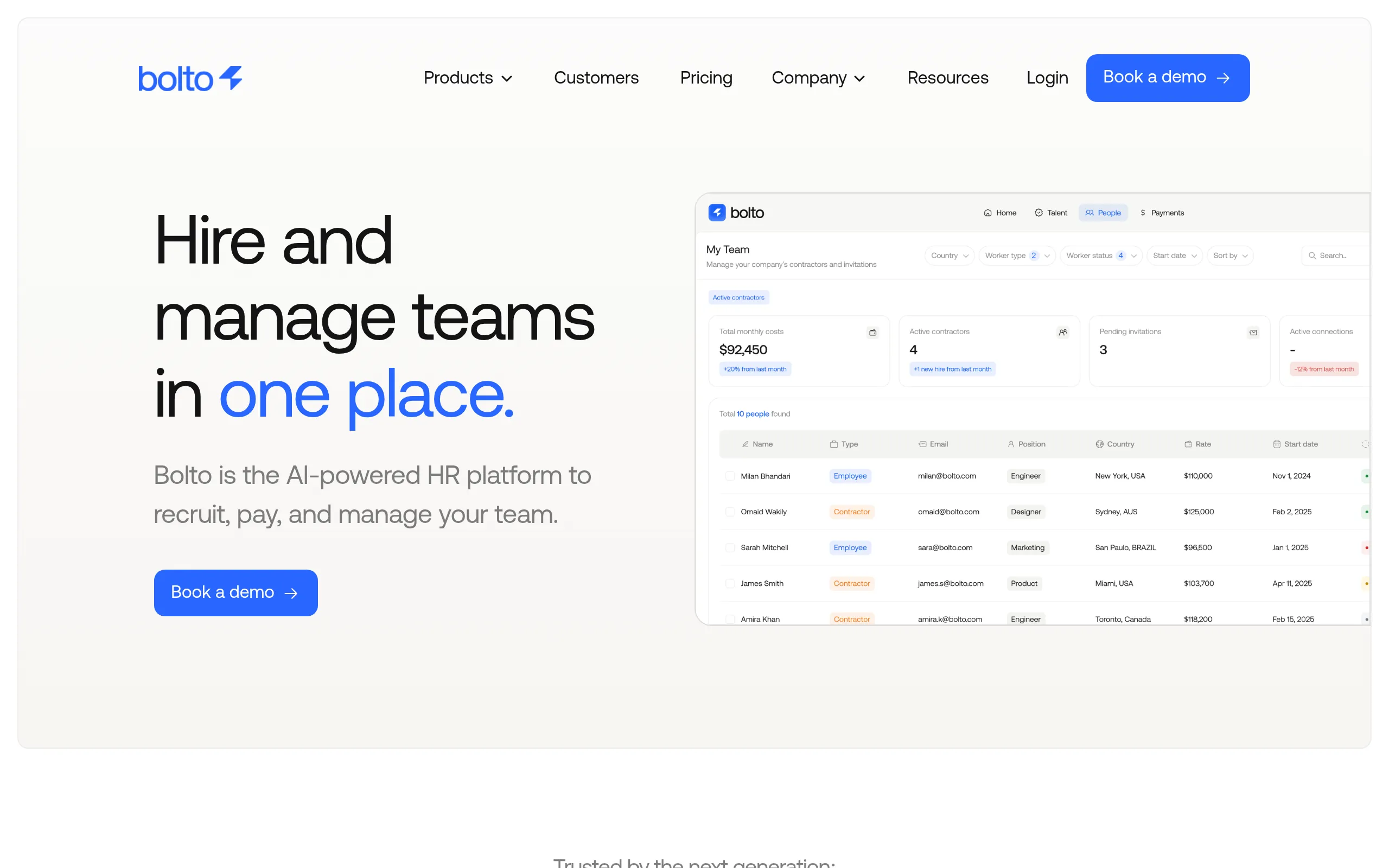
Bolto brings hiring, payroll, and compliance together in one AI enabled workflow. It blends Global EOR with multi country payroll and contractor management, anchored by a lightweight HRIS for fast onboarding, purpose built for startups and scale ups running both US and international teams.
-
Pricing: Starts at $49/month per contractor and $599/month per EOR employee, with custom enterprise plans available.
-
Coverage & compliance: Hire in 150+ countries with locally compliant contracts and onboard EOR employees in 48 to 72 hours, backed by 24/7 compliance support.
-
Best for: Venture backed startups and high growth companies that need unified US + global employment without building local entities.
-
Why it stands out: Transparent pricing and unusually fast, hands on EOR onboarding for small, distributed teams.
2. CloudPay
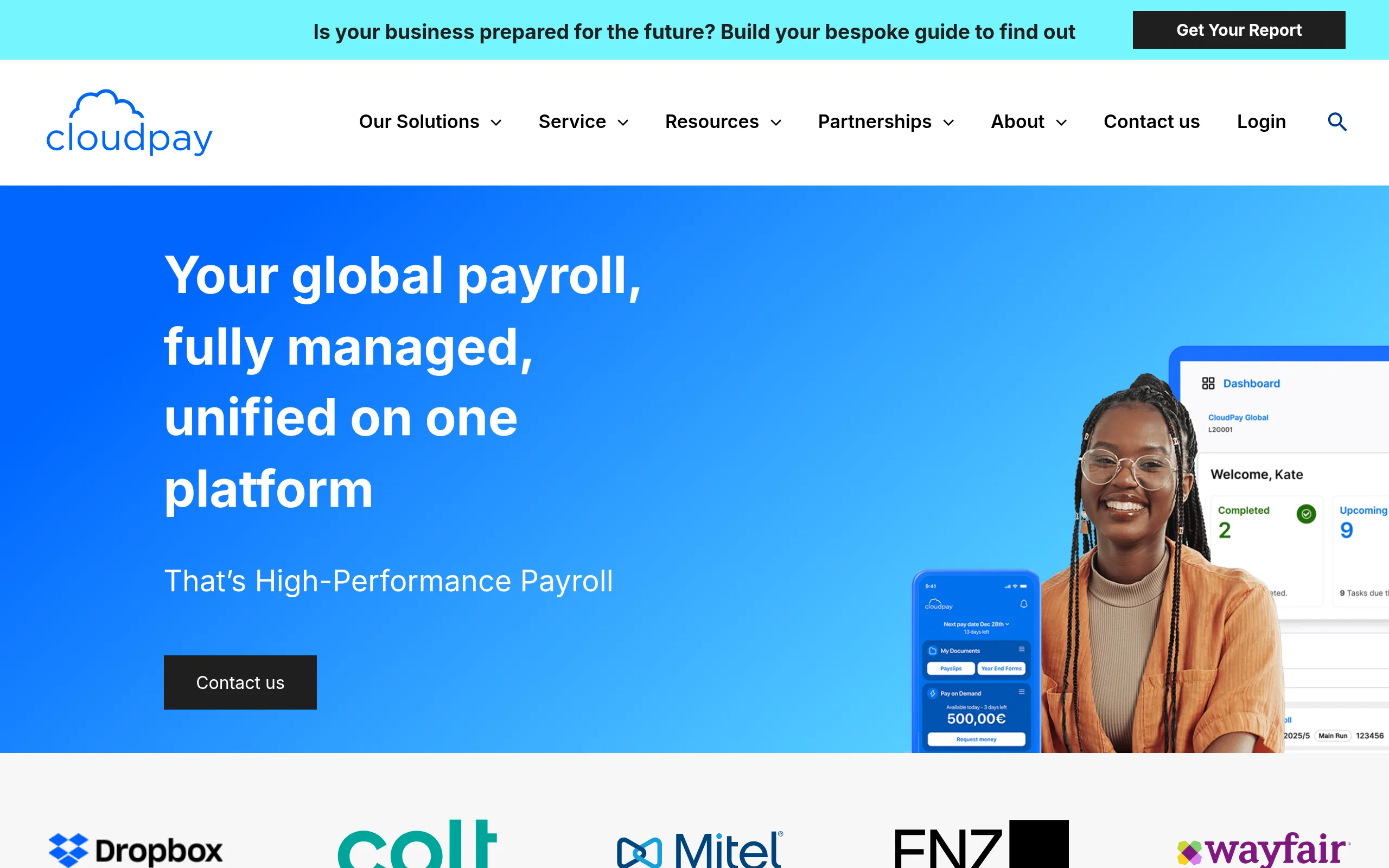
CloudPay centralizes global payroll processing and payments, pairing orchestration with robotic data validation and rich analytics. With certified integrations to Workday and SAP, it gives multinationals a standardized backbone for payroll and treasury across countries.
-
Pricing: From $20 per employee per month for the Growth package; fixed scope and tailored enterprise plans available.
-
Coverage & compliance: Payroll in 130+ countries and payments in 110+ currencies, with statutory tax filings and ISO 27001 level security.
-
Best for: Mid market to enterprise companies that want a single global payroll and payments experience.
-
Why it stands out: Unified payroll plus instant pay and earned wage access in one platform.
3. ADP Global Payroll
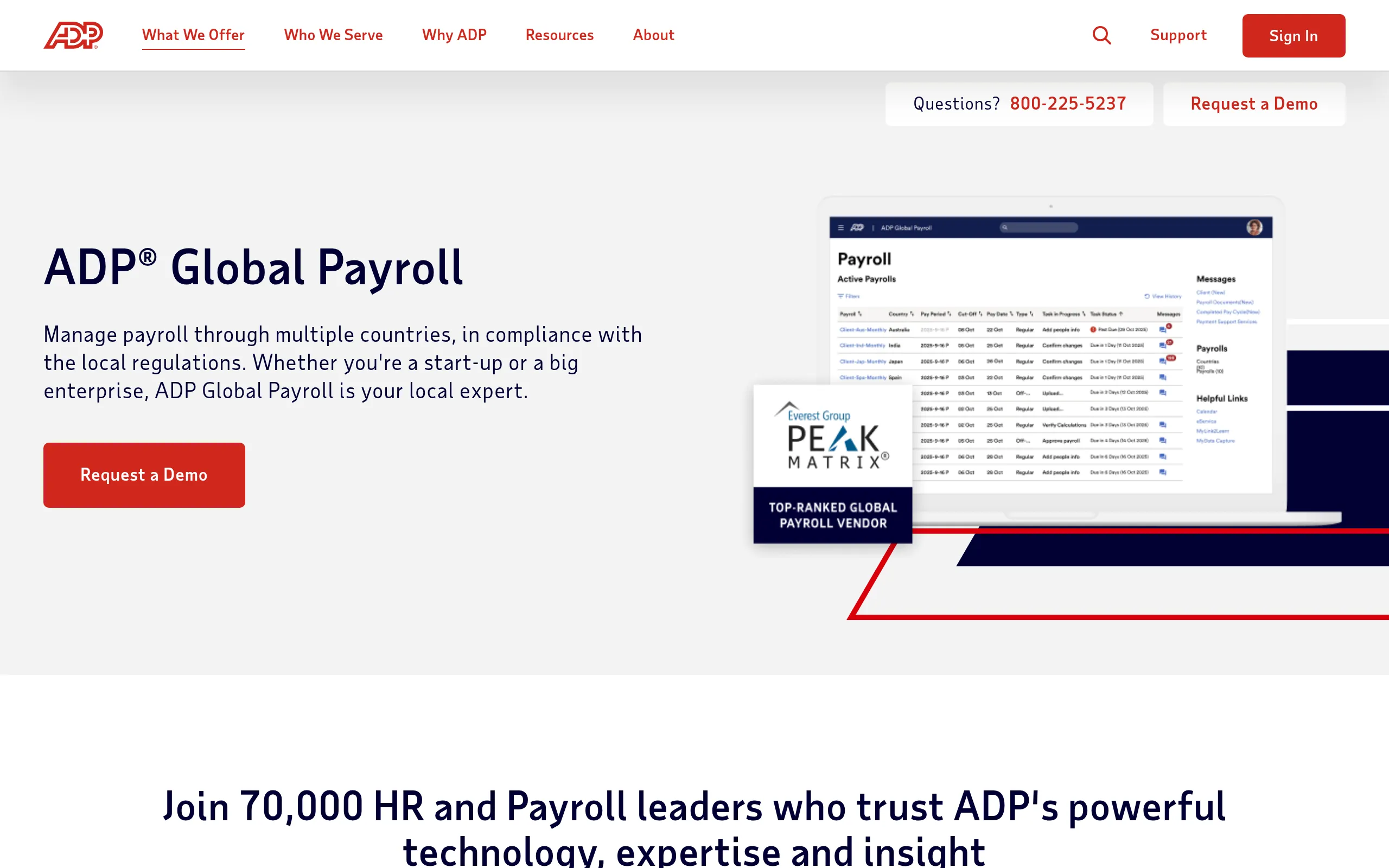
ADP consolidates multi country payroll for large enterprises through GlobalView and Celergo, delivering a single source of truth and open HCM connectivity. Marketplace partners extend the stack to EOR and contractor management when you need it.
-
Pricing: Quote based, tailored to scale, footprint, and complexity.
-
Coverage & compliance: Payroll in 140+ countries and EOR in 180+ via partners, with 140+ currencies and deep local compliance expertise.
-
Best for: Global enterprises seeking one strategic vendor with proven delivery at scale.
-
Why it stands out: Unmatched global footprint and consistent top tier analyst recognition.
4. Immedis Platform
Now UKG One View, this platform unifies global payroll operations, real time analytics, and managed services under one roof. It integrates with Workday and Oracle to give multinationals a consistent, validated experience across countries.
-
Pricing: Custom and quote based; no public rates or trials.
-
Coverage & compliance: Supports 160+ countries and 120 currencies, with an AI validation engine and managed in country statutory filings.
-
Best for: Large multinationals that need a real time, consolidated payroll view.
-
Why it stands out: Hybrid deployment paired with perpetual payroll data validation.
5. iiPay Global Payroll Services
iiPay’s aggregator model centralizes multi country payroll, payments, analytics, and services on one platform. With certified Workday and native HiBob integrations, it streamlines operations for mid market and enterprise teams spanning dozens of countries.
-
Pricing: Payroll outsourcing is quote based; ContractorPay starts at $1,400/month (annual billing). EOR pricing is custom.
-
Coverage & compliance: 170+ countries with payments in 130+ currencies, bolstered by FCA regulated payments and ISO 27001.
-
Best for: Enterprises consolidating payroll across 10 to 100+ countries with strong HCM connectivity needs.
-
Why it stands out: An embedded, FCA regulated global payments engine tightly coupled with payroll.
6. Safeguard Global Managed Payroll (GMP)
Safeguard Global combines multi country payroll, EOR, and contractor management with HR, benefits, and analytics modules. Its deep Workday integrations and in country experts help SMB and mid market teams expand with confidence.
-
Pricing: EOR from $499 per employee monthly; Contractor Management from $5 per contractor monthly; Global Managed Payroll is quote based.
-
Coverage & compliance: 187 countries for EOR/contractors and 170+ for payroll, with local entities managing tax filings and benefits.
-
Best for: Expanding SMBs and mid market organizations, especially those on Workday.
-
Why it stands out: Deep, certified Workday integration backed by broad geographic expertise.
7. Payslip
Payslip’s Global Payroll Control Platform standardizes data and orchestrates a network of local providers from one hub. It integrates with HCMs like Workday to centralize operations across employees, EOR, and contractors for large multinationals.
-
Pricing: Enterprise pricing is custom and quote based; no public per employee or EOR rates.
-
Coverage & compliance: Supports 190+ countries via a vendor agnostic network, with automated validations, audit trails, and ISO/SOC certifications.
-
Best for: Large enterprises unifying disparate payroll systems without ripping and replacing local vendors.
-
Why it stands out: A control layer approach with certified Workday integration.
8. Papaya Payroll
Papaya brings payroll, payments, and EOR together and connects cleanly to your HRIS. Its licensed payments engine and in country experts help mid market and enterprise teams streamline multi country pay at scale.
-
Pricing: From $15 per employee, $599 per EOR employee, and $30 per contractor monthly; quote based options available.
-
Coverage & compliance: 160+ countries and 130+ currencies with local expertise across taxes, benefits, and labor law.
-
Best for: Mid market to enterprise organizations consolidating payroll and payments globally.
-
Why it stands out: A regulated payments backbone fully integrated with global payroll and EOR.
9. Alight Global Payroll
Now operating as Strada, this enterprise platform unifies multi country payroll operations and analytics, meeting large organizations where they are. Certified, bidirectional integrations with Workday, SAP, and Oracle standardize processing across vast footprints.
-
Pricing: Quote based for enterprises; no public rates or trial.
-
Coverage & compliance: Payroll in 180+ countries and 25 languages, supported by local tax specialists and AI powered anomaly detection.
-
Best for: Global enterprises standardized on Workday, SAP, or Oracle.
-
Why it stands out: Extensive global scale paired with certified HCM integrations.
10. TMF Horizon
TMF Horizon centralizes payroll and HR while local TMF teams execute in country. The result is governed, on the ground delivery with a consolidated portal and certified integrations to Workday, SAP, and Oracle.
-
Pricing: Multi country payroll and HR administration are quote based; contractor services via its G P partnership start at $39/month.
-
Coverage & compliance: Payroll in ~150 jurisdictions through local experts; EOR/contractors in 180+ countries via G P, backed by ISO 27001.
-
Best for: Enterprises that value deep local execution with centralized visibility and control.
-
Why it stands out: A proven in country delivery model coupled with a unified global view.
Unifying Your Global Team with Smart Payroll
Managing multi country payroll is an unavoidable complexity of building a global team, but it doesn’t have to be a barrier to growth. The old approach of stitching together local vendors is slow, risky, and inefficient. Modern, unified platforms have emerged to solve this problem, offering a single system to ensure compliance, improve efficiency, and deliver a better experience for your employees. By choosing a solution that combines recruiting, HR, and payroll, you can accelerate your global ambitions, and plan where to build next with our guide to recruiting around the world.
Ready to stop wrestling with spreadsheets and start building your global team? Explore how Bolto combines recruiting, EOR, and payroll in one seamless platform.
Frequently Asked Questions About Multi Country Payroll
What is the average cost of multi country payroll?
Costs vary based on the model. EOR services are often a flat monthly fee per employee, ranging from $500 to $700. Payroll only services for existing entities can have different pricing structures. Always look for transparent, all inclusive pricing to avoid surprises.
How long does it take to implement a global payroll system?
With a modern, cloud based platform, implementation can be completed in a few weeks. The timeline depends on the number of countries, employees, and the complexity of your data migration.
Can a single platform handle both contractors and full time employees?
Yes, leading platforms are designed to manage payments for a company’s entire workforce. They can process payroll for full time employees and handle invoice payments for international contractors in one unified workflow.
What’s the biggest risk of getting multi country payroll wrong?
The two biggest risks are non compliance and employee churn. Compliance errors can lead to significant financial penalties and legal trouble. Payroll mistakes erode trust and are a major driver of employee dissatisfaction, which can lead to losing valuable talent.
Do I need a local entity to run multi country payroll?
If you want to hire employees directly, you typically need a local legal entity. However, an Employer of Record (EOR) service allows you to hire and pay employees compliantly in a country without establishing your own entity, dramatically speeding up your expansion. For country specific nuances, explore our guide to hiring employees vs. contractors in India.