

Best PEO Software in 2025: 8 Top Picks and Pricing

https://iad.microlink.io/AB3SGw-2RwEBKtV5I7Zd6hMWMAK_iKnCpDhHM0H8N7RXc_gX-W4Nucr2MbiHM-KSIBAireonCwJwvKsDS8IqAw.pnghttps://iad.microlink.io/iuhnshiLddaeK2DF2O8QgoykxTi3wHj6oumnphwEgAW_nIWmFoVbTEuP5TOz-rtm0aDY6VjH0Xkx3LLhYGJ4Gg.png# Best PEO Software in 2025: Top Picks and Pricing
Managing human resources, payroll, and compliance is a complex task, especially for startups and growing businesses. As you scale, the administrative burden can pull focus from your core product and customers. This is where a Professional Employer Organization, or PEO, comes in. PEO software provides the digital backbone for these services, offering a streamlined way to handle HR functions. However, the landscape is changing, with modern platforms offering more integrated solutions for today’s global and remote first companies.
What is PEO Software?
A Professional Employer Organization (PEO) enters into a co employment agreement with a company. This means the PEO becomes the employer of record for tax purposes, handling payroll, benefits, and compliance, while you retain control over managing your team and daily operations. PEO software is the technology platform that enables this relationship, giving you and your employees a centralized portal to manage everything from pay stubs to benefits enrollment.
This model bundles services that might otherwise require multiple vendors, like separate tools for payroll, HR, and compliance. While effective, it’s important to distinguish PEO software from alternatives like an Employer of Record (EOR) or all in one HR platforms. For instance, an Employer of Record (EOR) allows you to hire employees in countries where you don’t have a legal entity, a crucial function not always covered by traditional PEOs. Modern solutions like Bolto integrate global EOR, contractor management, and recruiting into a single system, offering a more flexible approach for companies building global teams.
Essential PEO Software Features
When evaluating PEO software, you’ll find a core set of features designed to offload your most time consuming HR tasks.
- Payroll Processing: This includes calculating wages, handling tax withholdings for multiple states, processing direct deposits, and managing W2s.
- Benefits Administration: PEOs leverage their large employee pools to offer competitive rates on health insurance, dental, vision, and 401(k) plans. The software provides a simple interface for employees to enroll and manage their benefits.
- Compliance and Risk Management: The software helps ensure you comply with federal, state, and local labor laws. This often includes workers’ compensation administration and access to HR experts for guidance.
- HRIS Functionality: A Human Resources Information System (HRIS) is central to PEO software. It acts as a digital filing cabinet for employee records, onboarding documents, time off tracking, and company policies.
- Time and Attendance Tracking: Many PEO platforms integrate tools for tracking hours worked, managing time off requests, and ensuring compliance with wage and hour laws. This is especially useful for businesses with hourly or non exempt employees.
- Reporting and Analytics: Modern PEO software provides dashboards and customizable reports on key HR metrics. This can include payroll costs, employee turnover, benefits enrollment data, and compliance tracking, giving leaders valuable insights for decision making.
Benefits of PEO Software
Adopting PEO software can provide significant advantages, particularly for small to medium sized businesses that lack a dedicated HR department.
- Reduced Administrative Burden: Automating payroll and HR tasks frees up founders and key personnel to focus on growth initiatives. Studies show that businesses using a PEO grow 7 to 9 percent faster.
- Access to Better Benefits: By pooling employees from many small companies, PEOs can negotiate for benefits packages typically reserved for large enterprises. This can be a major advantage in attracting and retaining top talent.
- Enhanced Compliance: The regulatory landscape is constantly changing. A quality PEO service helps mitigate the risk of costly compliance errors related to payroll taxes and labor laws. The IRS reports that around 40% of small businesses pay penalties for incorrect payroll filings each year.
- Consolidated Operations: Instead of juggling multiple vendors for payroll, benefits, and HR compliance, a PEO provides a single point of contact and a unified platform. For companies needing an even more integrated solution that includes recruiting and global hiring, it’s worth exploring platforms that consolidate these services from the start. See how Bolto combines everything in one place. Read the Fiber AI case study.
How to Choose the Best PEO Software
Selecting the right partner is crucial. Not all PEO software is created equal, and the best choice depends on your company’s unique needs.
Key Selection Criteria
- Assess Your Needs: Consider your current headcount, future growth plans, and whether you need multi state or global capabilities. If you plan to hire engineers internationally, a solution with built in EOR may be a better fit than a traditional PEO. For a practical overview, see our guide to recruiting around the world.
- User Experience: The software should be intuitive for both your administrative team and your employees. Request a demo to walk through common workflows like running payroll or onboarding a new hire.
- Transparent Pricing: Understand the full cost. Most PEOs charge a fee per employee per month or a percentage of total payroll. Ask about implementation fees, hidden charges, and what’s included in each tier.
- Customer Support: When an urgent payroll or HR issue arises, you need responsive and knowledgeable support. Look for providers that offer dedicated support managers, a feature that early stage founders often find invaluable.
- Scalability: Choose a platform that can grow with you. Can it handle increasing complexity as you add employees, expand into new states, or hire internationally?
Costs & Pricing of PEO Software
PEO pricing generally falls into two models. The most common is a flat fee per employee per month, which can range from $40 to over $200 depending on the services included. The second model is a percentage of your total payroll, typically between 2% and 12%.
When comparing costs, be sure to factor in the administrative savings and the value of the benefits packages. While a PEO can offer great value, it’s also wise to compare their model to the straightforward pricing of EOR services, which often have a simple, flat monthly fee for international employees. For example, Bolto’s Global EOR has clear pricing at $599 per month. See the full pricing.
Regulatory Compliance and Accreditation
Trust is a major factor when outsourcing your HR functions. To ensure a PEO provider is reputable, look for key credentials. The Employer Services Assurance Corporation (ESAC) offers accreditation that verifies a PEO’s financial stability, ethical conduct, and operational reliability. Additionally, some PEOs are certified by the IRS, which provides an extra layer of financial protection and assurance. Working with an accredited and certified PEO helps ensure they manage your payroll taxes and other sensitive responsibilities correctly.
Trends in PEO Software for 2025
The world of work is evolving, and HR technology is adapting. Here are the key trends shaping PEO software and its alternatives.
- Integration of AI: Artificial intelligence is being used to automate tasks like checking payroll for errors, screening candidates, and answering common employee HR questions, making processes faster and more accurate.
- The Rise of Global EOR: As more companies hire talent globally, Employer of Record (EOR) services have become a popular, more flexible alternative to setting up foreign legal entities. This “entity free” hiring model is a core component of modern global HR platforms.
- All in One Platforms: Founders are tired of fragmented toolchains. The market is shifting towards single platforms that combine recruiting, onboarding, payroll, benefits, and EOR. This unified approach eliminates the heavy coordination cost of using separate vendors for each function.
- Focus on Employee Experience: Leading platforms are investing heavily in creating intuitive, self service portals that empower employees to manage their own information, from updating personal details to accessing pay stubs and enrolling in benefits.
Top 8 PEO Software Solutions in 2025
Now that you have a clearer understanding of what to look for in a PEO, let’s explore the leading software solutions available in 2025. This curated list features the top 8 platforms that stand out for their comprehensive features, user friendly interfaces, and exceptional customer support. These solutions have been grouped together to represent the best options for businesses of various sizes and needs, from burgeoning startups to established enterprises.
1. PrismHR
PrismHR is the back office engine many U.S. PEOs and ASOs run on. It is purpose built to handle payroll, benefits, HR, and compliance at scale. If you’re building or upgrading a PEO, this is the platform tier that sits under your client facing service model.
- Best for: PEO/ASO back offices
- Starting price & contract: By quote for enterprise platform licensing; request a demo.
Expert take: For operators, PrismHR functions as an all in one operating system rather than a toolkit. It’s widely deployed, receives steady monthly enhancements, and offers a sizable marketplace of integrations to extend functionality without heavy custom builds. Security and compliance are table stakes here (SOC 2 Type II, audit friendly logs), and implementations are managed as enterprise projects with clear milestones. The tradeoff is that PrismHR is software for service providers, not an EOR, and it does not natively employ talent abroad. You’ll rely on partner connectors when clients expand globally. If you’re comparing to global first EORs, think of PrismHR as the infrastructure your U.S. PEO runs on, not the entity employing people overseas.
Standout features for global hiring & payroll:
- U.S. multi jurisdiction payroll with federal, state, and local tax automation
- Contractor handling and streamlined 1099 year end processing
- Built in compliance guardrails: I 9, automated E Verify case creation
- APIs/marketplace to extend globally, including a Papaya Global connector
- SOC 2 Type II security, MFA, role based access, and 24/7 monitoring
2. Worklio
Worklio is a white label back office platform purpose built for PEOs/ASOs, ideal if you want to embed payroll, HR, and benefits into your own branded experience without starting from scratch.
- Best for: White label PEO/ASO back office
- Starting price & contract: By quote for an all in one PEO/ASO software license; book a demo for details.
Expert take: Developer first is the headline here. With 1,000+ API endpoints and a UI component library, Worklio lets you stand up a branded experience in roughly 30 to 60 days and iterate quickly as your PEO scales. On the compliance side, it supports W 2 and 1099 workers in all 50 states, multi EIN structures, and automates federal, state, and local filings, encoding thousands of local rules so your teams don’t have to. Enterprise grade security (SOC 2 Type II, ISO 27001) on Azure and a 99.95% uptime target add confidence for regulated clients. Like other PEO platforms, it’s not a global EOR; to hire abroad you’ll bring your own entities or partner EORs.
Standout features for global hiring & payroll:
- Large scale U.S. payroll with multi EIN support and automated filings
- White label HRIS plus optional mobile app embedded in your brand
- 1,000+ API endpoints for rapid custom builds and integrations
- SOC 2 Type II and ISO 27001 certifications for security and audits
- End to end HR workflows (ATS, onboarding, PTO) on one platform
3. ADP TotalSource
ADP TotalSource pairs a mature, IRS certified PEO with the breadth of ADP’s ecosystem, which is useful for SMBs that want stability, buying power, and compliance rigor without assembling a stack themselves.
- Best for: US multi state SMBs
- Starting price & contract: By quote; PEO priced per employee. Self guided demo available; no free trial.
Expert take: TotalSource delivers 50 state payroll, tax filings, and enterprise grade benefits with risk transfer through an IRS certified PEO. You get a named HR business partner plus access to specialists, which helps lean teams navigate compliance and employee relations. Integrations are broad (300+ connectors) and deployments are measured in weeks, not months. The caveat is global hiring: TotalSource isn’t a native EOR, so you’ll route international payroll through ADP’s global solutions or marketplace partners. If your workforce is primarily U.S. based and you prize reliability and benefits leverage, ADP is a steady hand.
Standout features for global hiring & payroll:
- 50 state payroll, tax filings, workers’ comp, and compliance support
- Path to global payroll in 140+ countries via ADP sister products
- EOR partner integrations for hiring in 180+ countries
- 300+ pre built connectors and APIs for system integration
- IRS certification and ESAC accreditation underpin trust
4. TriNet
TriNet is a national, IRS certified PEO that wraps big company benefits, compliant payroll, and risk mitigation into one platform, making it well suited to founders who want a seasoned partner and responsive support.
- Best for: US SMBs needing co employment
- Starting price & contract: By quote for PEO services; demos are available.
Expert take: TriNet blends software with access to experts, giving you a dedicated relationship manager plus phone/chat support, often a step up from lightweight HRIS models. Its IRS certified and ESAC accredited status helps reduce payroll tax liability risk and calms board concerns during diligence. Implementation follows a structured playbook that typically takes about eight weeks. International employment flows through partner EORs, so global first teams may prefer a provider with owned entities; however, TriNet’s integration depth with accounting systems like QuickBooks and NetSuite makes back office operations straightforward.
Standout features for global hiring & payroll:
- Risk mitigation via IRS certified PEO and ESAC accreditation
- Global hiring through integrated EOR partners with a unified view
- Streamlined U.S. contractor onboarding and 1099 NEC generation
- Native payroll sync with QuickBooks, NetSuite, Xero, Sage Intacct
- Built in ACA reporting, workers’ comp, and access to EPLI
5. Insperity
Insperity is a long standing U.S. PEO combining co employment, a mature HRIS, and premium benefits access. This makes it ideal for startups and scaleups whose teams are primarily U.S. based.
- Best for: US multi state payroll
- Starting price & contract: By quote for PEO co employment; five employee minimum; demo by request.
Expert take: As a Certified PEO (CPEO), Insperity assumes federal employment tax liability on wages it pays and is treated as a successor employer, which is helpful during transitions to avoid wage base resets. You’ll work with a dedicated service team and can tap 90+ local offices for hands on guidance, a draw for founders who prefer human support over ticket queues. Contractor Management streamlines 1099 onboarding and payments. Tradeoffs include quote based pricing, a five employee minimum, and no owned global EOR; pair it with a specialist if you’re hiring abroad.
Standout features for global hiring & payroll:
- CPEO advantages to prevent FICA/FUTA wage base restarts
- Robust U.S. payroll with managed W 2 and tax filings
- Premium benefits access to compete for U.S. talent
- Automated 1099 onboarding, payments, and tax forms
- HRIS integrations for LMS, performance, and SSO
6. Justworks PEO
Justworks brings a modern, software forward PEO experience with transparent pricing and always on support, which is great for startups that want to get compliant fast and scale across U.S. states.
- Best for: US SMBs going global
- Starting price & contract: PEO from $79 per employee/month; EOR from $599/mo; book a demo.
Expert take: An IRS certified (CPEO) and ESAC accredited PEO, Justworks packages multi state payroll, benefits, and HR consulting in an intuitive UI. Implementation is fast by PEO standards, often two to six weeks, and the 24/7 support model is genuinely responsive. Where it shines against legacy PEOs is simplicity and integration ease. For global needs, Justworks pairs U.S. PEO with native EOR in over 20 countries and contractor payments in 60+ countries, a pragmatic one vendor approach for early international hiring.
Standout features for global hiring & payroll:
- Hire through Justworks entities in 24 countries
- Pay international contractors in 60+ countries and multiple currencies
- Automate U.S. payroll and year end filings (W 2, 1099, 940/941)
- 24/7 support, HR consulting, and master benefits plans
- Integrations with ATS/accounting tools like Greenhouse and QuickBooks
7. Paychex PEO
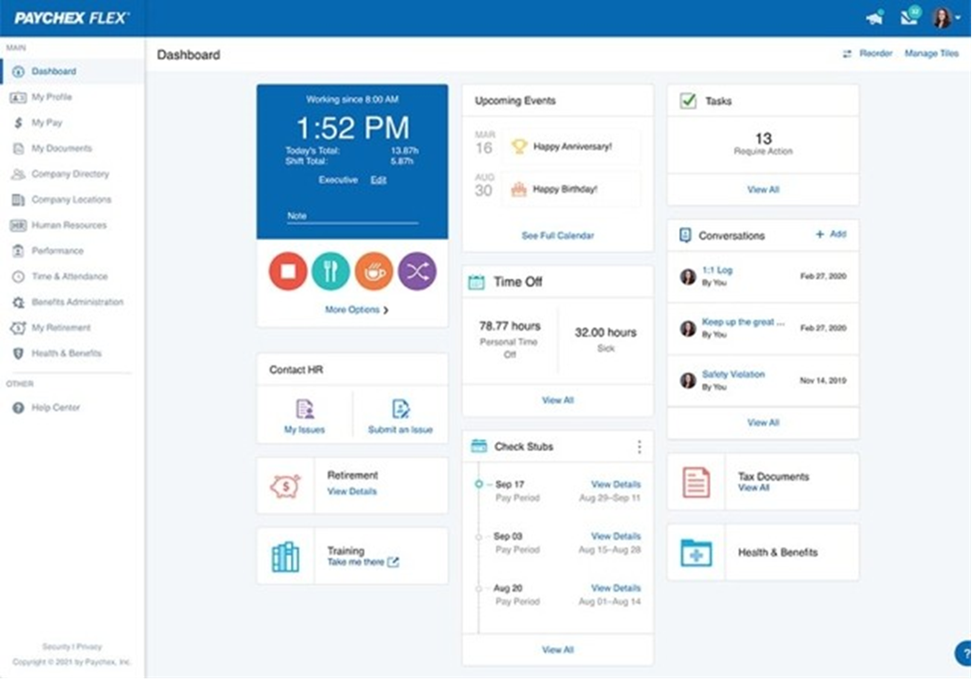
Paychex PEO combines co employment, the Paychex Flex HRIS, and a dedicated service team. This is a solid combination for U.S. centric startups that want compliance help and the convenience of one vendor.
- Best for: US multi state co employment
- Starting price & contract: By quote; U.S. PEO per employee/month; free consultation/demonstration.
Expert take: As a CPEO, Paychex assumes federal employment tax responsibilities and reduces ambiguity around liability. You’ll get named specialists (HR, payroll, benefits, relationship manager) and access to large group benefits pricing via Paychex sponsored plans. Implementation is guided, and cash flow is smoother with pay as you go workers’ comp. The limitation is global coverage: Paychex doesn’t operate its own EOR, so international hiring runs through partners. If your footprint is mostly domestic and you want a familiar brand with deep payroll chops, Paychex is a safe choice.
Standout features for global hiring & payroll:
- U.S. co employment with full service payroll and automated filings
- Global hiring via partners (G P, Multiplier) in 150 to 180+ countries
- HRIS essentials: e signatures, electronic I 9 with E Verify, remote onboarding
- Real time GL sync to QuickBooks, Xero, Sage Intacct
- Compliance guardrails with CPEO status and SOC 1/2 certifications
8. Rippling PEO
Rippling PEO lives inside a modern HRIS/IT platform, letting you turn PEO on or off without ripping out your core system. This is appealing for product led teams that value flexibility as they scale.
- Best for: Software first PEO + global scale
- Starting price & contract: PEO pricing by quote; core platform starts at $8 per employee/month (demo available).
Expert take: Rippling’s strength is unification, with HR, payroll, devices, and apps managed in one place, with powerful automations and 600+ integrations. For global teams, it runs EOR in 80 countries and supports contractor pay in 185+ with 50+ currencies, bringing most of your workforce into a single system of record. You’ll configure more yourself than with service heavy PEOs, but the tradeoff is speed and control. Pricing is modular and by quote, and while the security posture is strong (SOC 2, ISO 27001), note that Rippling is not a CPEO.
Standout features for global hiring & payroll:
- EOR in 80 countries with localized HRIS
- Contractor payouts in 185+ countries, 50+ currencies
- U.S. payroll automation with state/local tax account setup and filings
- HR + IT in one platform with 600+ integrations
- Enterprise grade security and real time support metrics
Conclusion / What’s Next?
Choosing the right PEO software can transform your HR operations, freeing you from administrative burdens and enabling you to offer competitive benefits. However, for ambitious startups, especially those with plans for a global workforce, the traditional PEO model may not be enough. The future of HR tech lies in integrated platforms that seamlessly combine recruiting, payroll, and global compliance in one place. These all in one solutions are built for speed and flexibility, helping you hire the best talent, wherever they are, and scale your business faster.
If you’re ready to move beyond fragmented tools and embrace a unified approach to HR, explore how an all in one platform can help you build your team. Early stage teams that only need payroll can get started with Bolto’s U.S. payroll for startups. Book a demo with Bolto today to see how it works.
PEO Software FAQs
What is the main difference between a PEO and an EOR?
A PEO (Professional Employer Organization) enters a co employment relationship with your company, bundling HR services for your entire US workforce. An EOR (Employer of Record) acts as the legal employer for your workers in a specific state or country where you don’t have an entity, allowing you to hire talent globally without setting up local subsidiaries. For country specific nuances, here’s a practical guide to hiring employees vs contractors in India.
Is PEO software suitable for very small startups?
Yes, many PEOs specialize in serving small businesses and startups with as few as 5 employees. They can provide immediate access to enterprise level benefits and HR infrastructure that would otherwise be out of reach. However, be sure to compare the costs to simpler, startup focused payroll solutions.
How does PEO software handle multi state payroll?
PEO software is designed to manage the complexities of multi state compliance. It automatically calculates and withholds the correct state and local taxes based on each employee’s location, and it files those taxes on your behalf, reducing a significant administrative burden.
What does co employment mean in a PEO arrangement?
Co employment is a contractual agreement where both the PEO and the client company have responsibilities as an employer. The PEO takes on administrative employer duties (payroll, taxes, benefits), while you, the client, maintain control over the employee’s daily tasks, responsibilities, and core job functions.
Can I switch PEO providers easily?
Switching PEOs can be complex because it involves transferring benefits, payroll data, and tax information. It’s often best to plan a switch for the end of a quarter or the end of the year to minimize disruption.
Does using a PEO mean I lose control over my employees?
No, this is a common misconception. With a PEO, you continue to direct your employees’ day to day work, manage their performance, and make all business decisions. The PEO simply handles the backend HR administration.