

Best HR Software for Midsize Companies 2026: 15 Top Picks

What is the best HR software for midsize companies? The right answer depends on your specific needs, but the top platforms all share a common DNA: they unify recruiting, payroll, and global compliance into a single, efficient system. For a growing business of 100 to 1,500 people, the best solution cuts administrative busywork, smooths compliance, and gives leadership a clear view of their entire workforce. This guide details how to choose the best hr software for midsize companies by breaking down the essential features for 2026, outlining a practical buyer’s process, and providing a direct comparison of the top 15 vendors in the market.
What is an HRIS? Definition, scope, and where it fits in your tech stack
An HRIS is the system of record for people data. It stores profiles, job information, compensation, time off, and documents, and connects to tools like payroll, benefits, identity, security, and accounting. For many teams comparing the best hr software for midsize companies, HRIS is the hub and everything else is a spoke. For a deeper dive, see our complete HRIS systems guide.
Core scope in 2026
- Employee records, onboarding, offboarding, and document management
- Time off and leave, basic scheduling, and approvals
- Payroll integration, tax filings support, and benefits sync
- Recruiting and assessments, or seamless integration to an ATS
- Global employment options through EOR or contractor workflows
- Reporting and analytics for headcount, compensation, and compliance
Where it fits
- Finance depends on HRIS for headcount and payroll accruals
- IT needs role changes and terminations synced to identity access
- Legal and HR rely on accurate histories for audits and disputes
- Hiring managers expect a smooth path from offer to productive day one
Essential HRIS features for midsize organizations
Choosing the best hr software for midsize companies is easier when you break features into must haves, nice to haves, and future needs.
Must haves
- Accurate source of truth for people data with role based permissions
- Native US payroll or a reliable payroll sync, including multistate support
- Automated tax filings for federal and state, plus W 2 and 1099 year end forms
- Global options, either EOR for employees or contractor management
- Custom fields and workflows that fit your policies without custom code
- Digestible reporting that non specialists can run
Nice to haves
- Built in recruiting and assessments to shorten time to hire
- Document templates with e signature and policy acknowledgments
- Time tracking and expenses for mixed employee and contractor teams
- Native payments in multiple currencies and a single monthly invoice
- API and common integrations for ATS, accounting, and identity
Future needs to plan for
- Global payroll expansion if you plan to hire in new countries
- Advanced security, audit trails, and role based data access
- Deeper analytics for org planning and total rewards
A combined platform like Bolto brings recruiting, EOR, contractor of record, and US payroll into one system, which can remove the swivel chair problem that slows midsize teams.
How to choose and shortlist the right HRIS
The best hr software for midsize companies balances capability with simplicity. Use this practical flow.
Step one, define outcomes
- Reduce time to hire and time to productivity
- Centralize payroll and contractor payments
- Cut manual tax filing risk and multistate errors
- Improve executive reporting and forecasting
Step two, map processes
- Document how a worker moves from candidate to paid employee or contractor
- Note handoffs among recruiting, HR, finance, IT, and hiring managers
Step three, build a shortlist
- Prioritize platforms that cover your entire flow, not only point features
- Ask for references from companies with similar size and hiring patterns
- Confirm what is native versus handled by partners
Step four, pilot and score
- Run a real onboarding, a contractor payment, and a termination
- Validate reporting for headcount, payroll, and compliance dates
- Measure clicks and time per task for your admins and managers
If you want one vendor to recruit global engineers and then hire them as employees or contractors with payroll handled, add Bolto to your shortlist.
Pricing and ROI: What HR software costs for midsize companies
Budgeting for the best hr software for midsize companies means understanding per employee fees, platform fees, and global employment costs.
What buyers see in 2026
- Many HRIS vendors charge a monthly platform fee plus a per employee fee
- EOR services are often priced per employee per month
- Contractor management can be a low fixed fee if you only need invoices, payments, and record keeping
Published examples you can verify on the Bolto pricing page
- Bolto US Payroll Launch plan is 39 per employee per month plus a 59 platform fee
- Bolto US Payroll Scale plan is 49 per employee per month plus a 99 platform fee
- Bolto Global EOR is 599 per employee per month with hiring in 100 to 150 plus countries
- Bolto Contractor of Record is 299 per contractor per month
- Bolto Contractor Management is 49 per month for invoicing, expenses, time tracking, and records
Market context from public discussions in late 2025 shows many EOR providers in the 500 to 600 per employee per month range. Using a unified platform can also reduce the need for separate recruiting agencies and separate payroll tools.
ROI levers to model
- Agency fees avoided when a platform delivers candidates and a 90 day replacement guarantee
- Lower time to hire and faster ramp for revenue facing teams
- Fewer payroll errors and faster close for finance
- One invoice for employees and contractors instead of separate wires across currencies
Our methodology for this list
This guide to the best hr software for midsize companies uses a simple, transparent rubric.
Evaluation criteria
- Breadth of platform across recruiting, HRIS, payroll, and global employment
- Quality and speed of talent sourcing and assessments if included
- Compliance posture for US multistate and international hiring
- Reporting usability for HR and finance leaders
- Customer proof such as time to hire, retention, and support quality
- Pricing clarity and total cost of ownership over three years
Facts we considered from published Bolto materials
- Average time to first candidate shortlist is about 72 hours
- A 90 day replacement guarantee on recruiting reduces risk
- Rebet built a four person engineering team in under five weeks with a 5.6 day average time to hire and 100 percent retention after one year
- Fiber AI hired five engineers and built an entire team in 10 days, then reported surpassing 1 million ARR afterward
- Assembly made a first ever engineering hire in 15 days from the first call and completed onboarding in under two days
- Payments and FX are supported in 150 plus countries with a single invoice
- 24 7 dedicated human support is advertised for EOR
- Bolto announced a 5.1 million seed round on March 5 2025 with investors including Y Combinator, General Catalyst, Morado Ventures, Amino Capital, and Alumni Ventures
These facts show how a combined platform can affect speed and confidence for midsize employers; see more customer outcomes.
Top 15 Best HR Software for Midsize Companies in 2026
Building on the considerations above, this section spotlights the 15 HR platforms that best fit midsize organizations in 2026. They’re grouped together because they balance breadth (core HR, payroll, and benefits) with depth in talent, analytics, and automation, while keeping complexity and costs manageable. Use the summaries that follow to see which tools align with multistate compliance, integrations, and the realities of lean HR teams.
1. Bolto
AI enabled and purpose built for distributed teams, Bolto brings global recruiting, U.S. multistate payroll, EOR, contractor management, and core HR into one flow. Payroll spins up in days with automated filings across all 50 states, while fast EOR onboarding and unified payments keep global teams moving. The HRIS focuses on the essentials rather than sprawling modules.

- Best for: US/global first companies (100–1,000 employees), engineering heavy teams, EOR and contractor ops, U.S. multistate payroll
- Pricing snapshot: US payroll $39–$49 PEPM + $59–$99 platform fee; EOR $599/employee/month; contractors $49–$299/month; Enterprise custom
Standout Capabilities & Trade offs:
- Strengths:
- Unified recruiting→EOR→payroll→contractor payments in one workflow
- Automated U.S. tax filings; marketed EOR reach in 150+ countries
- Watch outs:
- Fewer native integrations than larger marketplaces
- HRIS breadth is intentionally lighter than full HCM suites
2. ADP Workforce Now
ADP Workforce Now is a mid market staple that consolidates HR, U.S./Canada multistate payroll, time, benefits, and talent with strong compliance and DataCloud analytics. The Marketplace and connectors extend reach, while global payroll and EOR typically rely on adjacent ADP solutions or partners.

- Best for: Mid market, primarily U.S. employers (100–1,500 employees) needing dependable multistate payroll, compliance, and broad integrations
- Pricing snapshot: Quote based base + PEPM; payroll, benefits, and many integrations are add ons; EOR/global payroll typically contracted separately
Standout Capabilities & Trade offs:
- Strengths:
- Mature U.S. payroll/tax automation with benchmarked analytics (DataCloud)
- Expansive Marketplace for ATS/HRIS/ERP/accounting integrations
- Watch outs:
- Global payroll/EOR often require separate products/partners
- Paid connectors and implementation timelines can raise total cost
3. UKG Pro
UKG Pro delivers a deep HCM suite, including HR, payroll, and workforce management, built for midsize and global teams. Bryte AI adds guidance, while One View centralizes multicountry payroll visibility. Integrations and configurability are strengths, though implementation tends to be heavier than SMB first tools.

- Best for: 300–5,000 employees; complex scheduling; U.S. multistate payroll; multicountry payroll visibility
- Pricing snapshot: Quote based; modules a la carte; core HCM often in the high 20s to mid 30s PEPM; One View priced separately
Standout Capabilities & Trade offs:
- Strengths:
- One View unifies multicountry payroll data and oversight
- Strong WFM plus Bryte AI, 400+ integrations, frequent compliance updates
- Watch outs:
- No native EOR offering
- Implementation and ongoing administration can be heavier
4. Dayforce
Dayforce is an all in one HCM with continuous calculation payroll, time/scheduling, benefits, and talent, and includes Dayforce Wallet for earned wage access. Global payroll spans 200+ countries via a managed network and in region experts. It lacks native EOR but partners fill the gap; implementations are thorough and scoped.

- Best for: 100–5,000+ employees; multistate U.S. payroll with scheduling; unified global payroll visibility; EOR via partners
- Pricing snapshot: Undisclosed/quote based; core HCM often around $22 to $31 PEPM and up; services and EOR priced separately; implementation varies
Standout Capabilities & Trade offs:
- Strengths:
- Continuous calculation payroll and robust WFM with frequent compliance updates
- Managed global payroll across 200+ countries with local experts
- Watch outs:
- No native EOR; partner reliance adds complexity
- Quote based pricing and services can increase total cost
5. Paycom
Paycom’s single database HCM blends HRIS, U.S. multistate payroll, time, benefits, and talent with standout employee self service. Beti shifts payroll review to employees, reducing errors, while IWant accelerates data access. Global HCM visibility extends broadly, with native payroll in select countries.
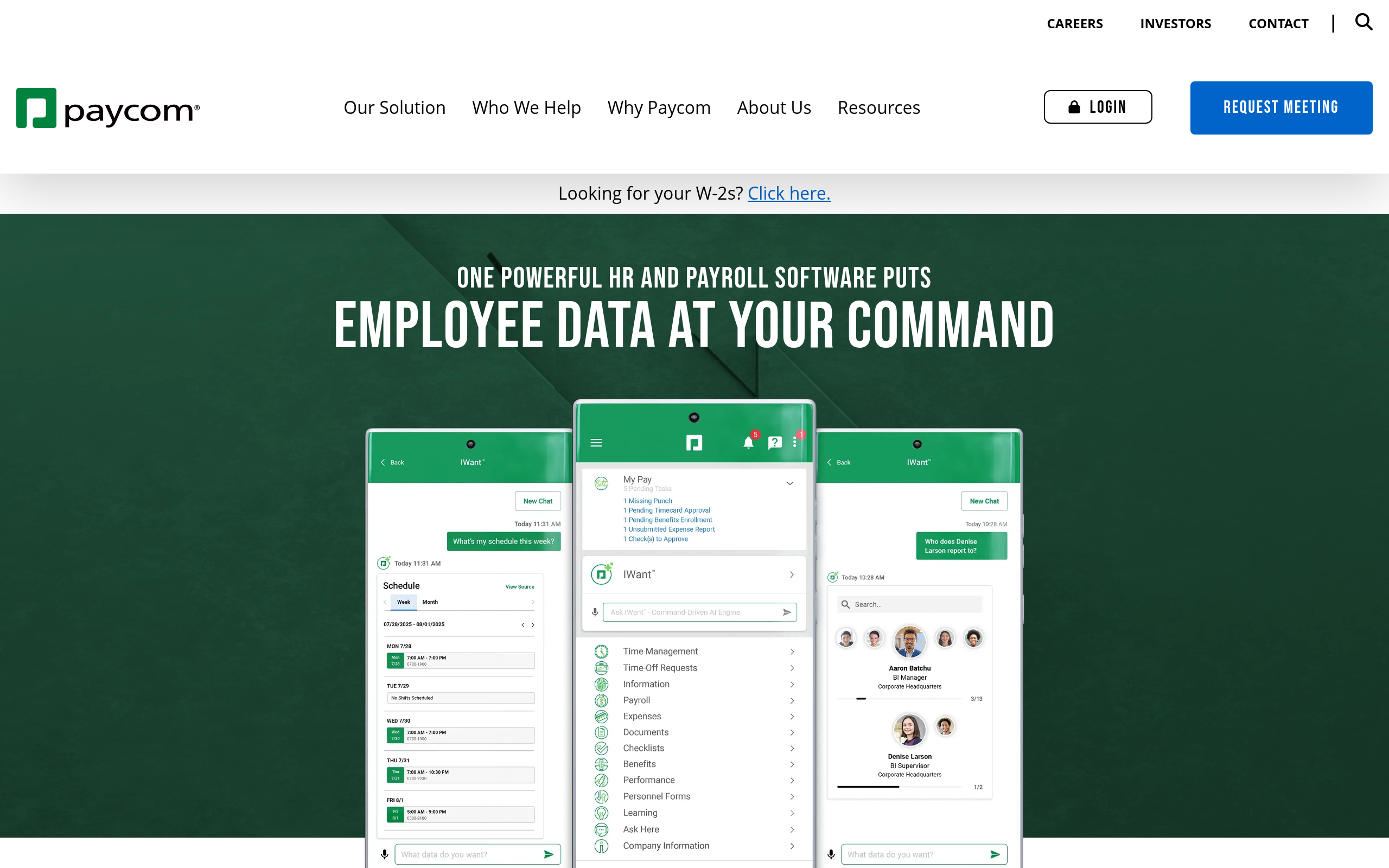
- Best for: U.S. headquartered midsize orgs (100–5,000) prioritizing HRIS + U.S. payroll and strong self service; lighter multicountry payroll needs
- Pricing snapshot: Undisclosed/quote based modular PEPM; per pay run fees common; implementation and add ons vary with headcount and pay frequency
Standout Capabilities & Trade offs:
- Strengths:
- Beti’s employee driven payroll cuts errors and HR workload
- Single database with strong mobile UX; IWant search speeds insights
- Watch outs:
- Closed ecosystem with limited third party integrations
- No native EOR for international hiring
6. Paylocity
Paylocity packages HRIS, time, benefits, talent, learning, and U.S. multistate payroll with strong tax filing and engagement features. Its acquisition of Airbase extends into spend management, while global payroll runs across 100+ countries via Blue Marble. EOR is not native.

- Best for: U.S. headquartered firms (100–1,500) needing multistate payroll, engagement forward HRIS, and basic global payroll without EOR
- Pricing snapshot: Quote based; example: $500 setup + $180 base + $10 PEPM; add ons for payroll, benefits, and global payroll
Standout Capabilities & Trade offs:
- Strengths:
- Deep U.S. payroll compliance, analytics, and employee engagement tools
- Robust integrations and GL connectors; spend management alignment
- Global payroll reach (100+ countries) with Blue Marble reporting
- Watch outs:
- No native EOR; pricing can vary by configuration and services
7. Paycor
Paycor’s mid market HCM suite combines HRIS, U.S. multistate payroll, time, scheduling, benefits, and recruiting with AI sourcing, analytics, and workflow automation. It’s strong for frontline and distributed teams. Global hiring/EOR is handled via marketplace partners; implementation follows its GUIDE methodology.

- Best for: U.S. based midsize orgs (100–2,500) needing multistate payroll, frontline scheduling, analytics, and partner powered EOR
- Pricing snapshot: SMB bundles from $99 base + $5 PEPM or $199 + $12 PEPM; mid market is custom; EOR via partners
Standout Capabilities & Trade offs:
- Strengths:
- Deep U.S. payroll compliance and year end execution
- AI sourcing, analytics assistant, 320+ integrations, developer tooling
- Watch outs:
- No native global payroll/EOR; partner add ons can complicate pricing and control
8. Rippling
Rippling unifies HRIS, U.S. payroll, benefits, time, recruiting, performance, and compliance with IT/device and Finance modules, reducing tool sprawl. It offers EOR in 80 countries, contractor pay in 185+, and global payroll. Implementations tend to be quick, though pricing and geography nuances apply.

- Best for: 100 to 1,500 employee U.S. companies consolidating HR, Payroll, IT, and Finance while expanding via EOR/contractors
- Pricing snapshot: Modular and quote based; HRIS from ~ $8 PEPM + base; U.S. payroll add on; global payroll ~$32–35; EOR ~$499; contractors ~$30
Standout Capabilities & Trade offs:
- Strengths:
- Unified HR + IT + Finance with 650+ integrations and automation
- Strong compliance workflows; Workflow Studio; weeks long implementations
- Watch outs:
- Quote based pricing can be complex; native global payroll coverage is limited
- No 24/7 support in all tiers; some IT constraints
9. HiBob
HiBob is a mid market HRIS designed for distributed teams, spanning core HR, onboarding, time, performance, compensation, engagement, analytics, and an integrated ATS. It ships native UK Payroll and a new 50 state U.S. payroll with bundled benefits; global payroll/EOR comes via partners.

- Best for: 100 to 2,000 employee scale ups and mid market teams needing HRIS, US/UK payroll, and partner based EOR/contractors
- Pricing snapshot: Quote based; core HR often $16–$25 PEPM; U.S. payroll + benefits bundled; UK payroll add on; EOR via partners
Standout Capabilities & Trade offs:
- Strengths:
- Unified HRIS + ATS with performance, engagement, and analytics; 100+ integrations
- Native UK payroll and broad U.S. payroll with PlanSource benefits
- Watch outs:
- Global payroll/EOR run via partners; U.S. payroll is newer, so validate complex edge cases
10. Personio
Personio is a European centric HRIS covering core HR, recruiting, performance, time, and documents for midsize teams. It offers native German payroll, EU payroll prep and integrations, plus embedded EOR via Remote. Automation and 200+ integrations stand out, though there’s no native U.S. payroll.
- Best for: EU HQ or U.S. companies with sizable European presence (100–1,500) needing HRIS, EU payroll, and embedded EOR
- Pricing snapshot: Quote based Core/Core Pro with add ons; German payroll separate; EOR via Remote priced per country
Standout Capabilities & Trade offs:
- Strengths:
- EU grade compliance (GDPR, ISO 27001), 200+ integrations, automation/analytics
- Native German payroll; strong EU payroll preparation flows
- Watch outs:
- No native U.S. payroll
- Partner operated EOR may add operating constraints
11. UKG Ready
UKG Ready brings HR, time, scheduling, and U.S. payroll together for midsize teams, with continuous calculations, robust pay rules, and Bryte AI to automate tasks. It integrates via the Solutions Exchange and can pair with One View for multicountry payroll visibility. EOR is not first party.

- Best for: U.S. centric employers (100–1,000) with strong time/scheduling needs and multistate payroll; add One View for global visibility
- Pricing snapshot: Undisclosed; often quoted around ~$21 PEPM; One View licensed separately; costs scale with headcount
Standout Capabilities & Trade offs:
- Strengths:
- Powerful time/scheduling and pay rules cut errors and rework
- Bryte AI accelerates payroll workflows; integrations are expanding
- One View adds multicountry payroll oversight
- Watch outs:
- No first party EOR; ATS and some integrations are basic
12. Darwinbox
Darwinbox is an AI forward HCM that spans HRIS, time, recruiting, performance, engagement, learning, service desk, and analytics. Its localization shines with native payroll in India, GCC, Indonesia, Philippines, and Thailand (Singapore/Malaysia expected early 2026). It typically integrates with a U.S. payroll provider.

- Best for: 250–5,000 employees; APAC/MENA heavy orgs needing global HRIS with localized payroll; pair with U.S. payroll/EOR specialists
- Pricing snapshot: Undisclosed modular pricing; midsize deals ~ $120k/year; payroll/benefits vary by market; no native EOR; implementation scope based
Standout Capabilities & Trade offs:
- Strengths:
- Strong APAC/MENA payroll coverage; AI enabled HR service desk
- Broad integrations (ATS/ERP/collab) and solid SLAs; mobile first UX
- Watch outs:
- No native U.S. payroll or EOR; validate U.S. payroll integrations
13. BambooHR
BambooHR is a user friendly HRIS that now includes U.S. multistate payroll and benefits, solid analytics, and embedded global hiring via Remote’s EOR. It’s approachable for HR teams and employees alike. International payroll/EOR runs in partner systems; UK/AU connections and marketplace integrations extend reach.

- Best for: U.S. HQ teams (~100–1,000) seeking intuitive HRIS, U.S. payroll/benefits, and light global EOR/contractor management
- Pricing snapshot: From $10 PEPM (published); ≤25 employees from $250/month; U.S. Payroll/Benefits are add ons; EOR via Remote priced by country
Standout Capabilities & Trade offs:
- Strengths:
- Full service U.S. payroll with tax filing, W2/1099, integrated time/benefits
- Embedded global hiring via Remote; UK/AU connectors; marketplace breadth
- Watch outs:
- International payroll runs on partner stacks; some connectors are one way with separate logins
14. Gusto
Gusto centers on U.S. payroll with multistate taxes, time, PTO, scheduling, expenses, and benefits, now with global contractors in 120+ countries and EOR via Remote in select markets. It’s easy to deploy and operate; deeper enterprise configuration is limited.

- Best for: U.S. centric orgs (50–400 employees) needing multistate payroll, benefits, global contractors, and a light EOR footprint
- Pricing snapshot: Plus $80 base + $12 PEPM; Premium $180 + $22; EOR $699 PEPM ($399 India/Philippines); contractors $35 + $6
Standout Capabilities & Trade offs:
- Strengths:
- Strong U.S. payroll/tax automation with built in time/PTO and expenses
- Pay global contractors in 120+ countries; EOR via Remote is expanding
- Watch outs:
- Narrow EOR footprint and lighter configurability; limited off hours SLAs
15. Zoho People
Zoho People offers a modular, budget friendly HRIS for core HR, time/attendance, performance, and learning, integrated with the wider Zoho suite plus Microsoft 365/Slack. U.S. payroll runs in separate Zoho Payroll with limited native integrations outside specific markets; no native EOR.

- Best for: Cost conscious midsize firms (100–800) needing HRIS, time/attendance, performance, and approvals, plus separate U.S. payroll
- Pricing snapshot: HRIS $1.25–$4.50 PEPM; People Plus $9 PEPM; U.S. Payroll $29 + $5 PEPM (multistate $49 + $7)
Standout Capabilities & Trade offs:
- Strengths:
- Low HRIS TCO with transparent tiers; economical at midsize scale
- Strong time/attendance: geofencing, IP restrictions, GPS kiosk
- Works across Zoho; Microsoft 365 and Slack workflows
- Watch outs:
- No native EOR; limited People to Payroll integrations outside select countries; partner based global payroll
Implementation and adoption roadmap
Even the best hr software for midsize companies will miss the mark without a clear rollout. Use this phased plan.
Phase one, prepare
- Clean your people data and define required fields
- Freeze policy changes during migration
- Map integrations for payroll, identity, and accounting
Phase two, pilot
- Onboard one department and one location
- Run parallel payroll or contractor payments for one cycle
- Validate reports against finance and HR expectations
Phase three, launch
- Train admins, managers, and employees with short recorded modules
- Use checklists for day one tasks and a feedback form for issues
- Set a cutover date, communicate early, and keep office hours
Phase four, optimize
- Automate recurring tasks with workflows and templates
- Add global EOR or contractor of record as hiring expands
- Review permissions and audit logs every quarter
For a combined recruiting to payroll flow with global options, explore Bolto.
Compliance and reporting for midsize employers
Compliance is where the best hr software for midsize companies proves its value. Look for automation plus clear controls.
Must have controls
- Accurate worker classification between employee and contractor
- Automated US federal and state payroll tax filings
- Year end W 2 and 1099 preparation and delivery
- Local labor and tax compliance for countries where you hire through EOR
- Secure document storage, versioning, and policy acknowledgments
Helpful reports and dashboards
- Headcount by department, location, and employment type
- Overtime and time off liabilities
- Payroll register and tax payment summaries
- Offer to start time and attrition by cohort
- EOR cost by country to guide expansion
Bolto centralizes these workflows and pays employees and contractors within one system, which gives finance and HR a shared record of truth. If global hiring is part of your plan, see the EOR and contractor options at Bolto.
Measuring success and continuous improvement
Define success metrics before you go live. Then review them monthly in a simple dashboard. Teams using the best hr software for midsize companies usually track the following.
People and hiring
- Time to first candidate shortlist and time to hire
- Offer acceptance rate and first year retention
Operations
- Payroll accuracy and number of support tickets per cycle
- Cycle time from approved offer to productive day one
- Percentage of automated workflows versus manual steps
Finance and risk
- Total cost per hire and agency fees avoided
- Error rates in tax filings and compliance findings
- EOR and contractor spend by region versus plan
Case study benchmarks show what good can look like. For example, Bolto reports 72 hours to first shortlist and documented time to hire measured in days, including a 5.6 day average in one case. These outcomes can materially improve delivery timelines for product teams.
Conclusion
The best hr software for midsize companies in 2026 simplifies the entire worker lifecycle, from sourcing to compliant payroll at home and abroad. Favor platforms that shorten time to hire, automate compliance, and give finance and HR a single view of truth. If your team wants one vendor for recruiting, US payroll, global EOR, and contractor management, take a closer look at Bolto. Book a quick walkthrough at Bolto to see how a combined platform can speed hiring and reduce admin.
FAQs
What defines the best hr software for midsize companies in 2026
Breadth of capability across HRIS, payroll, recruiting, and global employment, strong compliance automation, easy reporting, and a roadmap that scales with headcount.
How much does the best hr software for midsize companies usually cost
Vendors often charge a platform fee plus a per employee fee. For example, Bolto publishes 39 to 49 per employee per month for US payroll plans, with global EOR at 599 per employee per month and contractor of record at 299 per contractor per month.
Can one platform handle recruiting, EOR, and payroll for a midsize company
Yes. Platforms like Bolto combine AI powered recruiting, EOR across 100 to 150 plus countries, contractor management, and US payroll in one flow.
How fast can midsize companies expect to hire with a modern platform
Bolto case studies report first shortlists in about 72 hours and time to hire in days for engineering roles. Results vary by role and region.
What compliance features matter most for midsize employers
Automated federal and state tax filings, accurate worker classification, W 2 and 1099 completion, secure document storage, and local compliance for EOR countries.
Does the best hr software for midsize companies help with contractor payments
Yes. Look for invoicing, time tracking, expense review, and multi currency payments with a single monthly invoice. Bolto supports contractor payments in 150 plus countries.
How do we measure ROI after switching platforms
Track time to hire, payroll accuracy, agency fees avoided, cycle time to first paycheck, and support ticket volume. Compare outcomes for at least two quarters after go live.
Where can we see a live demo that covers recruiting plus payroll
You can request a walkthrough at Bolto to see recruiting, EOR, contractor of record, and US payroll running in one place.