

10 Best HRIS for Small Business (2026 Picks + Guide)

Growing teams need structure, not spreadsheets. An HRIS for small business centralizes people data, payroll, time off, onboarding, and compliance in one system so owners and ops leaders spend less time clicking and more time building. This guide explains what an HRIS is, why it matters for small companies, the features to prioritize, 2025 trends, pricing, and a simple path to selection and rollout. If you also need recruiting, global hiring, or startup friendly payroll, platforms like Bolto combine these into one stack.
What is an HRIS vs HRMS vs HCM and how cloud HRIS work
An HRIS for small business is software that stores employee records, manages core HR workflows, and connects payroll and benefits. HRMS and HCM are broader labels that often include advanced talent modules, analytics, performance, and workforce planning. For most small teams, a modern cloud HRIS is enough.
How a cloud HRIS works
- Single system of record, employee profiles, documents, job and compensation data
- Workflow engine for onboarding, offboarding, approvals, time off, and document e signature
- Integrations to payroll, benefits, accounting, identity, and applicant tracking
- Role based access so managers and employees self serve
If you prefer one vendor for HRIS, payroll, contractors, and global hiring, consider Bolto which pairs HRIS with recruiting, US payroll, EOR, and contractor payments.
Why small businesses need an HRIS, not just enterprises
An HRIS for small business is not overkill. It reduces admin, improves compliance, and speeds hiring and onboarding. Practical reasons
- New hire reporting is required in every US state, commonly within 20 days of hire
- Employers file Form 941 quarterly for federal payroll taxes
- W 2 forms must be provided to employees by January 31, and 1099 NEC to contractors by January 31
- Most US states require workers compensation coverage
- The Affordable Care Act applies to employers with 50 or more full time equivalent employees
These are routine tasks that software can automate. A lightweight HRIS also creates a better employee experience with clear time off balances, policy access, and faster payroll fixes.
Key HRIS features to look for, small business edition
Focus on must haves that map to your size and growth plan.
Core essentials
- Employee database with custom fields and secure document storage
- Onboarding checklists, I 9 and W 4 workflows, e signature, device and app provisioning tasks
- Time off and holidays with accrual rules, balance carryover, and manager approvals
- Payroll sync for W 2 and 1099, multi state tax profiles, and off cycle runs
- Benefits admin or clean export to your broker
- Compliance center with reminders for I 9 reverification, training, and certifications
- Reporting for headcount, payroll cost, turnover, and diversity basics
- Mobile friendly self service for address, bank, and tax updates
Security and reliability
- Role based permissions and audit logs
- Single sign on support, SAML or OIDC
- SOC 2 Type II or equivalent controls, encryption at rest and in transit
- Regular backups and clear uptime status
Nice to have for the next stage
- Performance reviews and goals
- Simple org chart and compensation bands
- Lightweight ATS or clean integrations to your recruiting tools
If you want one login for recruiting, payroll, contractors, and HRIS, Bolto is designed for startups and growth companies.
2025 HRIS trends for small business and common AI features
What is new and useful in 2025
- AI assisted onboarding that auto detects missing forms and suggests task owners
- Resume and profile parsing that pre fills HRIS fields from offer letters and ATS data
- Policy copilots that draft handbook sections from templates, then route for approval
- Time off anomaly detection that flags inconsistent accruals or balances
- Automated compliance timelines for multi state tax registrations and filings
- Integrated global workflows across EOR, contractors, and US payroll in one system
What to watch
- Responsible AI, clear human in the loop and audit trails
- Data privacy by design, especially if you have team members in the European Union under GDPR
- Interop maturity, open APIs and prebuilt connectors to accounting and identity providers
Platforms like Bolto pair AI screening for recruiting with HRIS and payroll so small teams can hire and activate talent in days.
Benefits you can expect from adopting an HRIS
An HRIS for small business delivers both hard and soft wins. For example, see how Rebet built a full engineering team and onboarded in under five weeks.
Operational wins
- Faster onboarding, many teams cut new hire setup from days to hours
- Fewer manual errors in payroll and tax filings due to centralized data and validations
- Cleaner audits with organized docs and e signatures
- Reduced time spent on employee questions through self service
Compliance and risk
- Timely quarterly Form 941 and annual W 2 or 1099 NEC handling
- Automated reminders for I 9 verification and reverification
- Proper multi state profiles for state unemployment and withholding
- Better data retention and access controls
People experience
- Clear time off balances and request flows
- Consistent offers and titles that support fair pay practices
- A single place to find policies, benefits, and pay history
Costs and pricing for HRIS software
Typical pricing for an HRIS for small business
- Per employee per month, often 6 to 20 dollars for core HRIS features
- Base platform fee, sometimes 0 to 200 dollars per month depending on support level
- Add ons for payroll, benefits, and performance
What to verify before you sign
- Implementation or migration fees
- Support model, business hours coverage and response targets
- Data export and contract terms
Example pricing from a startup friendly vendor
- US payroll Launch plan from Bolto at 39 dollars per employee per month plus a 59 dollars platform fee
- US payroll Scale plan from Bolto at 49 dollars per employee per month plus a 99 dollars platform fee
- Global EOR from Bolto at 599 dollars per employee per month
- Contractor of Record from Bolto at 299 dollars per contractor per month
- Contractor Management from Bolto at 49 dollars per month
For plan details and the latest rates, see our pricing page.
How to choose the best HRIS for your small business
Use a short, practical process.
- Define must have workflows
Onboarding, time off, US payroll, multi state, contractor payments, and basic reporting are common for an HRIS for small business. - Map your hiring plan
If you will hire in India, Latin America, or Eastern Europe, shortlist options that include EOR or contractor management with country expertise. Bolto combines recruiting, EOR, and payroll. - Score vendors on four areas
- Fit to workflows and integrations
- Security and compliance posture
- Support quality and references
- Total cost of ownership
- Run a two week pilot
Move one real hire through the full flow, from offer to first paycheck. - Negotiate clean terms
Clarity on support, uptime, data export, and renewal notice.
Global ready considerations for SMBs if you hire internationally
An HRIS for small business needs a few global guards if your team crosses borders. If you’re weighing payroll engines across countries, read our guide to multi‑country payroll solutions.
- EOR lets you employ people without opening a local entity, your provider becomes the legal employer
- Many countries have statutory benefits and leave, the HRIS should localize entitlements
- Several countries use 13th month salary, for example Brazil and the Philippines
- Currency and FX fees add cost, look for bulk payments and single invoice workflows
- Data privacy rules vary, GDPR in the European Union, LGPD in Brazil, and PIPL in China
- Classification matters, employees versus contractors, and rules differ by country
One vendor can simplify this. Bolto supports EOR in 100 to 150 plus countries and pays contractors alongside employees.
Implementation basics and change management
A calm rollout beats a big bang. Keep it simple.
Plan
- Pick an owner and a small project team, HR or ops plus finance and IT
- Freeze a start date and a first payroll cycle in the new system
- Inventory current forms, policies, and templates
Migrate
- Clean your data, names, emails, job titles, start dates, comp, tax forms
- Import employees and contractors, then attach documents
- Connect payroll, benefits, accounting, and identity
Test
- Dry run time off accruals and a sample payroll
- Send offer letter to a test hire and complete onboarding
Adopt
- Train managers and employees with a short video and a Q and A
- Set a two week feedback window for fixes and improvements
With platforms like Bolto, recruiting to payroll can happen in one workflow, which shortens rollout time.
Top 10 HRIS for Small Business
Moving from strategy to selection, this section spotlights ten HRIS platforms built with small businesses in mind, comparing their strengths across onboarding, time tracking, payroll, benefits, compliance, and integrations. If you’re also comparing broader HR platforms beyond HRIS, check our guide to the best HR software for small business. They’re grouped here because each combines essential HR capabilities with approachable pricing and setup, making them practical choices for lean teams that want to standardize processes without adding complexity.
1. Bolto Global HR

Bolto Global HR brings recruiting, core HR, payroll, and global hiring into one streamlined flow, which is ideal when a lean team needs to move from “offer signed” to “first paycheck” without juggling tools. It covers the HR essentials (records, documents, PTO, onboarding/offboarding) while automating U.S. payroll filings and guiding compliance as you add multi‑state workers or expand abroad with contractors and EOR.
Startup snapshot
- Best‑for: US startups scaling globally; engineering‑heavy teams
- Pricing & trial: Payroll from $39/month; demo
- Payroll/EOR footprint: US taxes; EOR in 100+ countries
- Integrations: Major HR/accounting apps, ATS connectors, background checks
Why it stands out for small, global‑leaning teams: Bolto compresses the hire‑to‑pay journey. Recruiting feeds straight into HR and payroll, with AI‑assisted candidate shortlists to accelerate staffing. You can start on US payroll, then flip on contractors, multi‑country payroll, and EOR without migrating data. Automated filings and compliance prompts reduce risk for multi‑state startups. Caveat: it’s a newer HRIS with fewer named integrations, so confirm the connectors and pricing tiers you’ll need.
Essential capabilities for small/global teams:
- Core HR (records, PTO, policies) with guided onboarding
- US payroll with automated W‑2/1099 and tax filings
- Global EOR and contractor management from the same system
- Single‑invoice payments and lightweight analytics
2. Rippling

Rippling is a true all‑in‑one for small teams that want HR, payroll, IT, and spend under one roof. Core HR, time, benefits, and policies flow into a single employee record, making it easy to onboard, run payroll, and report across states or borders without stitching together multiple systems.
Startup snapshot
- Best‑for: Startups/SMBs needing unified HR, payroll, and IT
- Pricing & trial: From $8; quote‑based; no trial
- Payroll/EOR: US payroll; EOR in 80 countries; contractors in 185+
- Integrations: 600+ including Greenhouse, QuickBooks, NetSuite, Xero, Slack
Why it stands out for small, global‑leaning teams: Speed is the headline, featuring fast implementations, 90‑second onboarding, and automations that pull hours out of admin work. As you grow, you get device management, app provisioning, spend controls, and robust analytics, avoiding tool sprawl. Global hiring is turnkey with EOR and contractor support. Caveat: modular, quote‑based pricing and no self‑serve trial can make budgeting less transparent.
Essential capabilities for small/global teams:
- HRIS + payroll automation with multi‑state compliance
- Global EOR, contractor payments, and multi‑currency payroll
- 600+ integrations and APIs with granular access controls
3. BambooHR

BambooHR keeps HR simple and approachable for small teams: clean employee records, slick onboarding with e‑signatures, PTO tracking, and clear reports. Add BambooHR Payroll for automated U.S. filings, or extend globally with an embedded EOR partner, so you can manage domestic and international staff in one familiar interface.
Startup snapshot
- Best‑for: US SMBs/startups wanting fast HRIS, PTO, onboarding; optional payroll and light global hiring
- Pricing & trial: From $10 PEPM; ≤25 users from $250/month; 7‑day core and 14‑day Time trials; add‑ons extra
- Payroll/EOR footprint: US payroll with federal/state/local filing, W‑2/1099s, multi‑EIN; EOR in 90+ countries (Remote)
- Integrations: 150+ including Greenhouse, Lever, QuickBooks Online, Slack, Zapier
Why it stands out for small, global‑leaning teams: Fast setup and intuitive workflows help lean HR teams modernize quickly. Multi‑state payroll and compliance tools (like a 50‑state handbook builder and PFML support) reduce risk. Embedded EOR is a pragmatic path to hire abroad without a new system. Caveat: international payroll/EOR relies on partners, and add‑ons can push up total cost.
Essential capabilities for small/global teams:
- Core HR with workflows and e‑signatures
- US payroll automation for W‑2/1099s and multi‑state filings
- Embedded EOR coverage across 90+ countries
- 150+ integrations spanning ATS, accounting, and chat
4. Gusto

Gusto is payroll‑first and startup‑friendly: get your first run out the door quickly, then layer on HR basics like self‑service onboarding, time, PTO, and benefits. It handles federal, state, and local filings automatically, while Gusto Global lets you pay contractors worldwide and add EOR in select countries as you expand.
Startup snapshot
- Best‑for: US SMBs/startups needing fast payroll with HR basics
- Pricing & trial: From $49 base + $6/person; trial via Xero
- Payroll/EOR footprint: US payroll; EOR in 11 countries; contractors in 120+
- Integrations: QuickBooks, Xero, FreshBooks; Greenhouse, Lever; Shopify, Homebase
Why it stands out for small, global‑leaning teams: Guided setup and employee self‑onboarding make first payroll painless. Transparent pricing and solid support fit early budgets, while global contractor pay and EOR options provide a simple path abroad. Caveat: EOR coverage is limited and deeper HR workflows may require higher tiers or add‑ons.
Essential capabilities for small/global teams:
- Unlimited payroll with automated tax filings
- Self‑service onboarding, PTO, and time tracking
- Global contractor payments plus EOR in 11 countries
- Popular accounting/ATS integrations and stable APIs
5. Zenefits

TriNet Zenefits brings HR, benefits, time, and payroll together so small teams can run compliant people ops without heavy lifting. Paperless onboarding flows straight into payroll, employees self‑serve via web and mobile, and multi‑state filings keep distributed workforces compliant.
Startup snapshot
- Best‑for: US SMBs/startups needing quick all‑in‑one HR
- Pricing & trial: Quote‑based per‑employee pricing; demo only
- Payroll/EOR footprint: US payroll with W‑2/1099; global EOR via partners
- Integrations: QuickBooks, Xero, NetSuite, Intacct; Greenhouse, Lever
Why it stands out for small, global‑leaning teams: It’s quick to digitize onboarding, sync time and PTO into payroll, and keep your accounting in lockstep. Marketplace partners extend hiring to 180+ countries while retaining a unified HR record at home. Caveat: pricing is not publicly transparent, and global payroll/EOR requires separate partner contracts.
Essential capabilities for small/global teams:
- Core HR and payroll automation with multi‑state filings
- Paperless onboarding with e‑sign and background checks
- Contractor payments and 1099 reporting
- Integrations, SSO, and a broad Marketplace
6. Zoho People

Zoho People is a budget‑friendly HRIS that gets the basics right. It includes employee records, onboarding with e‑sign, PTO, time/attendance, and clean reporting so you can stand up HR in days. Visual workflows and Blueprints help automate approvals without code, and the broader Zoho suite covers recruiting, accounting, and expenses.
Startup snapshot
- Best‑for: Budget‑conscious SMBs/startups needing core HR fast
- Pricing & trial: From $1.50 PEPM; 30‑day trial
- Payroll/EOR footprint: US payroll (via Zoho Payroll); no native EOR
- Integrations: Zoho Recruit/Books/Expense, QuickBooks, Slack/Teams, Zapier
Why it stands out for small, global‑leaning teams: Exceptional TCO and speed mean you can start small, automate quickly, and expand via the Zoho ecosystem or APIs. US teams can enable 50‑state payroll when ready; global teams can link to EOR/contractor providers while keeping HR centralized. Caveat: no first‑party EOR and region‑limited People↔Payroll integrations mean you should validate connectors ahead of time.
Essential capabilities for small/global teams:
- Onboarding with e‑sign, templates, and checklists
- Workflows/Blueprints that automate approvals and reminders
- Time, attendance, shifts, and geo/IP controls
- Integrations and analytics via Zoho and REST APIs
7. GoCo
GoCo is built for small businesses first: centralized records, fast onboarding with e‑signatures, PTO, and tidy reporting. Its Magic Docs and Workflows automate repetitive HR tasks, while you can either keep your existing payroll synced or turn on embedded U.S. payroll powered by Gusto.
Startup snapshot
- Best‑for: US SMBs needing flexible HRIS and quick onboarding
- Pricing & trial: Quote‑based; base ~ $99 + ~ $5 PEPM; no trial
- Payroll/EOR footprint: US payroll via Gusto; EOR in 90+ countries via Remote
- Integrations: QuickBooks, ADP, Paychex, Greenhouse, JazzHR, Checkr, Remote, Zapier
Why it stands out for small, global‑leaning teams: You can modernize HR without ripping out payroll. Auto Payroll Sync lets you keep what works, or you can enable embedded payroll and keep everything in one flow. Multi‑state compliance features (remote I‑9, E‑Verify, state tax prompts) are practical for distributed teams. Caveat: global employment runs through Remote pricing, and embedded payroll inherits Gusto’s constraints (e.g., employer‑printed checks).
Essential capabilities for small/global teams:
- Magic Docs, e‑signatures, workflows, and PTO
- Embedded US payroll with automated filings
- Remote EOR/contractor management with synced records
- Prebuilt integrations plus QuickBooks and Zapier
8. Factorial
Factorial offers a modular HRIS that grows with you: start with employee records, onboarding, e‑signatures, documents, and add time, PTO, scheduling, or a light ATS as needed. Multi‑entity settings and payroll cycles help distributed SMBs keep control while syncing payroll data to regional engines.
Startup snapshot
- Best‑for: SMBs/startups needing modular core HR, time, PTO, docs, and light ATS
- Pricing & trial: From $8 per user/month (US plans 10‑seat minimum); free trial and demo
- Payroll/EOR footprint: No native US payroll; syncs to QuickBooks Payroll; EU connectors (DATEV, Silae, Sage 50, a3innuva); no first‑party EOR
- Integrations: QuickBooks, Microsoft Business Central, LinkedIn, Teamtailor, Recruitee, Workable, Slack, Okta, Zapier, Power BI
Why it stands out for small, global‑leaning teams: Quick time‑to‑value with out‑of‑the‑box onboarding and legal e‑signatures, plus a structure that supports multiple entities and localized fields. Predictable TCO via modular packaging and a useful marketplace. Caveat: no built‑in US payroll or first‑party EOR means you should plan for integrations.
Essential capabilities for small/global teams:
- Core HR, onboarding, e‑signature, and a light ATS
- Time, PTO, scheduling with mobile geofencing
- Payroll data sync and payslip distribution
- Multi‑entity controls, API, and Power BI reporting
9. Sage HR
Sage HR (formerly CakeHR) keeps people ops focused and affordable. It offers clean records, onboarding with e‑signatures, PTO, timesheets, shift scheduling, expenses, and a lightweight ATS, all accessible on web and mobile. It’s simple to export clean datasets to payroll in any region or link to Sage 50 where available.
Startup snapshot
- Best‑for: Budget SMBs needing modular HRIS
- Pricing & trial: From $6 PEPM; 30‑day trial
- Payroll/EOR footprint: No native payroll/EOR; ties into Sage 50 in some regions
- Integrations: Sage 50, Slack, REST API
Why it stands out for small, global‑leaning teams: Low TCO and fast setup mean you can start with Core HR + Leave, then add modules as needs grow. For US/Canada teams on Sage 50, the linkage creates a pragmatic HR‑to‑payroll bridge. Multi‑language UX and exportable reports fit global‑leaning operations. Caveat: no first‑party payroll or EOR, and analytics are basic.
Essential capabilities for small/global teams:
- Core HR, e‑signatures, workflows, and automation
- PTO, timesheets, shift scheduling with clean exports
- Lightweight ATS and simple analytics
- Slack integration and open REST API
10. Paychex Flex
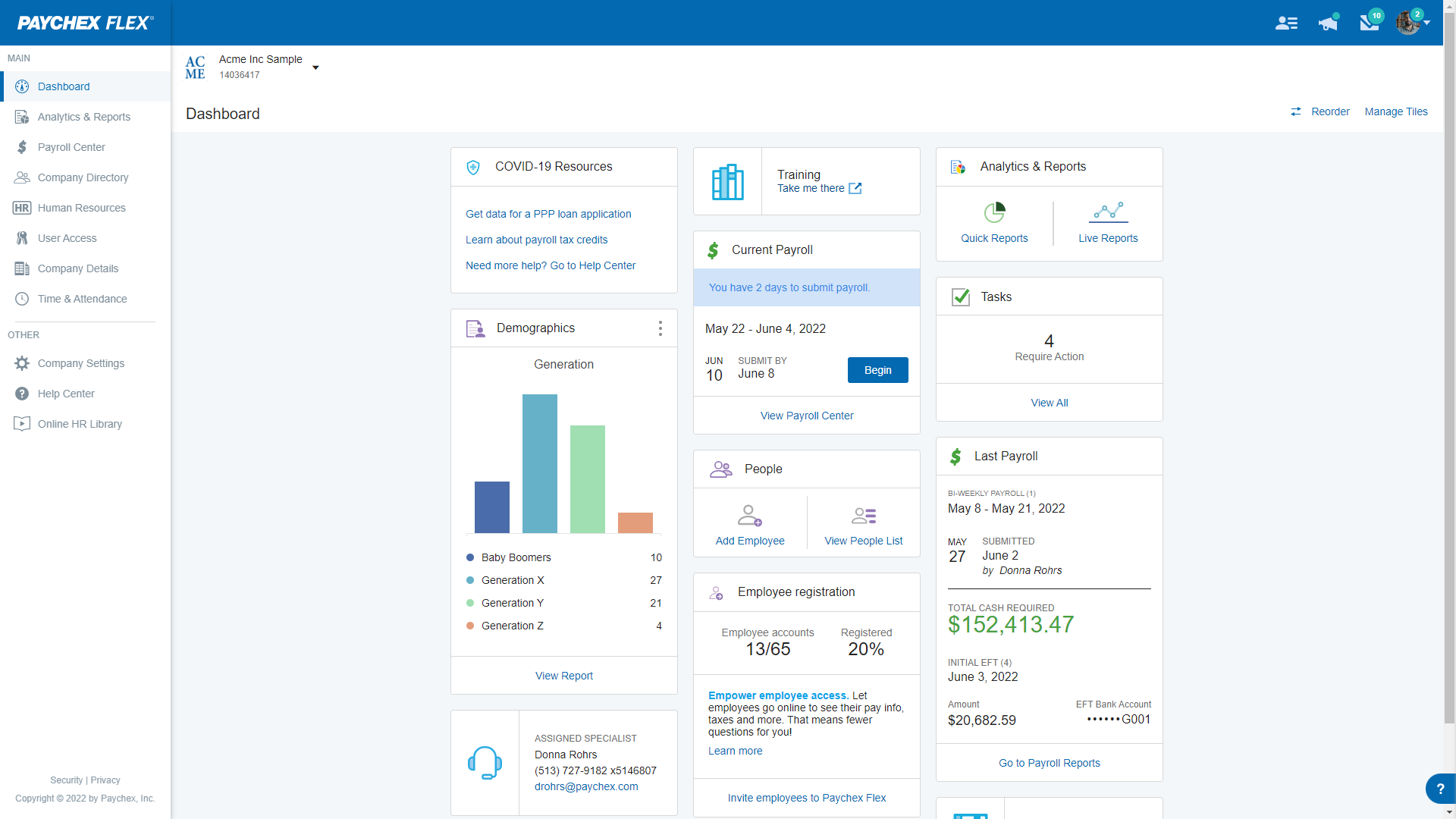
Paychex Flex is a proven choice when you need U.S. payroll done right, fast. It layers in HR, onboarding with e‑sign/I‑9/E‑Verify, PTO, optional time and benefits, plus dashboards and reporting, giving small teams a dependable backbone for multi‑state compliance.
Startup snapshot
- Best‑for: U.S. SMBs/startups needing fast, compliant payroll
- Pricing & trial: Quote‑based; from ~$39 base; no trial
- Payroll/EOR: U.S. payroll; global hiring via G‑P partner
- Integrations: QuickBooks, Xero, Sage Intacct, BambooHR, iCIMS
Why it stands out for small, global‑leaning teams: Multi‑state taxes are handled out of the box, and Paychex Pre‑Check lets employees preview pay to catch errors before payday, a huge benefit for lean teams. It scales into time, benefits, 401(k), and even a PEO, with solid integrations and analytics. Caveat: global employment isn’t native (you’ll work through G‑P), and add‑ons can increase total cost.
Essential capabilities for small/global teams:
- Automated taxes, W‑2/1099, and Pre‑Check for accuracy
- Onboarding with e‑sign, I‑9, and E‑Verify workflows
- Accounting integrations and APIs (QuickBooks, Xero, Intacct)
- Global hiring via G‑P plus 1099‑NEC support
Other resources for small business owners
Use these checklists and reminders as you evaluate an HRIS for small business.
- Payroll compliance, quarterly Form 941, annual W 2 and 1099 NEC, state registrations for withholding and unemployment
- New hire reporting to states, commonly due within 20 days
- Workers compensation coverage in most states
- Overtime and minimum wage rules under the Fair Labor Standards Act
- Paid sick leave mandates in several states and cities
- Data retention rules for I 9 and payroll records
- Security posture, SOC 2 Type II reports and single sign on options
- Global considerations, GDPR requirements and 13th month pay practices
Conclusion
An HRIS for small business turns scattered files and repetitive checklists into clear workflows and accurate data. It saves time, reduces payroll and compliance risk, and creates a better employee experience. If you also need to source engineers, hire globally, and run US payroll without juggling five tools, consider one vendor that does it all. See how Bolto combines recruiting, HRIS, payroll, EOR, and contractor payments to help teams hire and ship faster.
FAQs
What is the difference between HRIS, HRMS, and HCM
HRIS focuses on core records and workflows. HRMS and HCM are broader suites that can include talent management, learning, and advanced analytics. For many small teams, an HRIS for small business is the right scope.
Does an HRIS include payroll
Some do, some integrate. If you want HRIS and payroll in one place, a platform like Bolto offers US payroll plus contractor payments with HRIS features.
How much does an HRIS for small business cost
Entry plans often run 6 to 20 dollars per employee per month plus a base fee. Costs rise with payroll, benefits, and advanced modules.
What compliance tasks can an HRIS automate
Common items include new hire reporting, I 9 completion and reverification, Form 941 reminders, W 2 and 1099 NEC prep, and state registration tracking.
Can an HRIS support global teams
Yes, if it integrates with EOR and contractor management. Look for localized leave and benefits, multi currency pay, and privacy controls like GDPR support.
What data security should I expect
Baseline items include SOC 2 Type II audits, encryption, role based access, and single sign on. Ask for audit logs and export options.
How fast can we implement an HRIS
Small teams often go live in two to four weeks. A focused pilot with one new hire and one payroll cycle is a good pattern for an HRIS for small business.
When should I upgrade from spreadsheets
If onboarding takes more than a day, if payroll changes cause errors, or if you operate in multiple states, it is time for an HRIS for small business.