



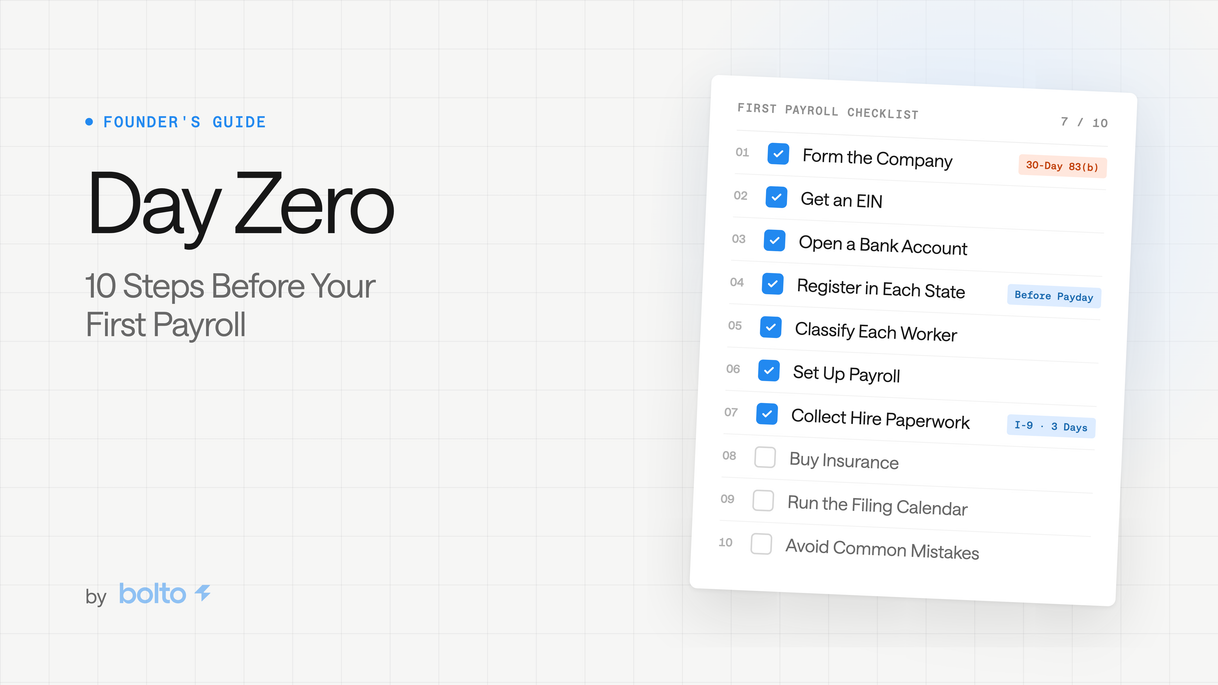
Ten things stand between a new company and its first payroll. Most of them can wait their turn. Two of them start a clock.
To file, counted from the day you issue founder stock.
Every state account must be open before it goes out.
This guide is for a US company hiring its first US employee: the steps in order, the deadlines that matter, and what Bolto handles along the way.
The 10 Steps in Order
- 01FirstForm the Company83(b) within 30 days of issuing stock
- 02After formationGet an EINFree, issued instantly online
- 03After the EINOpen a Bank AccountApproval time varies by bank
- 04Before the first paycheckRegister in Each StateVaries by state, so start early
- 05Before anyone is paidClassify Each WorkerNo deadline, steep penalties
- 06Before the first pay dateSet Up PayrollLeave time for the first deposit
- 07The hire’s first dayCollect Hire PaperworkI-9 in 3 business days; new-hire report in 20 days
- 08Before day oneBuy InsuranceWorkers’ comp required in most states
- 09Quarterly and JanuaryRun the Filing CalendarForm 941 quarterly; 940 and W-2s by Jan 31
- 10AlwaysAvoid Common MistakesLate deposits penalized from 2%
1. Form the Company and File Your 83(b) Within 30 Days
Venture-backed companies usually incorporate as a Delaware C-corp, because investors expect it. A bootstrapped business is often simpler and cheaper as an LLC in its home state.
Have these ready on filing day:
- Registered agent: every state requires one, with a local street address for legal notices.
- Bylaws and board consent: banks and investors ask for both.
- Founder stock with vesting: the standard is 4 years with a 1-year cliff.
- 83(b) election: file within 30 days of the stock transfer. Put it on the calendar the day you issue shares.
- IP assignment: every founder, employee, and contractor assigns their work to the company.
- Cap table: record every issuance from day one.
Use a startup attorney here. Equity and tax mistakes are the most expensive to fix later.
2. Get Your EIN in Minutes
An Employer Identification Number (EIN) is your company’s federal tax ID. It’s free: form the company first, then apply on irs.gov and you’ll get it immediately. Ignore any site that charges for one.
- The application times out after 15 minutes of inactivity, so finish it in one sitting.
- You’ll need your entity type and the SSN or taxpayer ID of the person who controls the company.
- Save the confirmation letter.
You need an EIN to hire and to file employment taxes. Get one even as a solo founder, to keep company and personal finances separate.
3. Open a Business Bank Account Before the First Dollar Moves
Keep company money separate from day one. Mixing funds weakens your liability protection and makes payroll hard to trace.
Bring your certificate of incorporation, EIN, and bylaws, plus ID and proof of address for anyone who owns more than 25%. Approval times vary, so apply early.
- Fund it before payroll: it must cover wages and employer taxes on every pay date.
- Consider a payroll-only account: it makes tax deposits easier to track and limits exposure if your main account is compromised.
- Mind the $250,000 limit: FDIC insurance covers $250,000 per depositor, per bank, per ownership category. A seed round can exceed that on day one.
4. Register in Every State Before the First Paycheck
Each state where you have an employee usually needs two accounts, one for withholding and one for state unemployment insurance (SUI), and each has its own agency, rates, and wage base. Registration takes time, so start before the first paycheck.
You’ll also need a way to pay federal taxes electronically. The IRS accepts deposits through the free Electronic Federal Tax Payment System (EFTPS), your IRS business tax account, or Direct Pay.
A remote hire in a new state may also require:
- Foreign qualification: registering your company to do business in that state.
- A registered agent there: depending on the state and your activity. Ask your attorney or agent provider before the start date.
5. Classify Each Worker Before You Pay Them
Decide whether each person is a W-2 employee or a 1099 contractor before you pay them. Employees need tax withholding, employer payroll taxes, and benefits. Contractors generally don’t.
The IRS weighs three things: behavioral control, financial control, and the relationship between you. If it’s unclear, treat the person as an employee or ask an employment attorney. Some states use stricter tests than the IRS.
Early teams often lean on contractors to stay lean. Get this right before the arrangement grows.
6. Set Up Payroll Before the First Pay Date
Use payroll software from your first hire. Running it by hand adds risk with every employee. Once your EIN, state accounts, bank account, and paperwork are in place:
- Pick a pay schedule. Biweekly is 26 pay periods a year; semi-monthly is 24. Some states set a minimum frequency.
- Choose software or a PEO. Software handles wages, withholding, and filings. A professional employer organization (PEO) becomes your co-employer and also manages benefits, HR compliance, and workers’ comp, for a higher price.
- Create employee records. Legal name, address, SSN, pay rate, and W-4 elections.
- Check tax settings. Confirm the right federal, state, and local jurisdictions, especially for remote employees.
- Set up direct deposit. Leave lead time for the first deposit.
- Add benefit deductions. Do it before the first run; fixing them later is slow.
- Run the first payroll. Only once records, tax accounts, bank details, and pay dates are verified.
7. Collect First-Hire Paperwork Before the First Payday
Every new employee needs five things on file before their first payday:
- A signed offer letter
- A federal W-4
- Any state withholding form
- A completed Form I-9
- Direct deposit details
Three deadlines:
- Form I-9: the employee completes their part by day one; you complete yours within 3 business days.
- New-hire report: file with your state within 20 days of the hire date.
- State registration: done before the first paycheck (step 4).
8. Buy Insurance Before the First Employee Starts
Have coverage in place before day one. Three policies matter in year one:
- General liability: the baseline for any company.
- Workers’ compensation: required in most states once you hire. Premiums are an employer cost on top of salary.
- Directors and officers (D&O): add it when you raise outside money.
9. Run the Filing Calendar Every Quarter and Every January
Payroll taxes repeat every pay period, quarter, and year, and the IRS penalizes late deposits from day one. Put these dates on a shared calendar the week you run your first payroll.
| Cadence | Filing or Action | Due |
|---|---|---|
| Each pay run | Deposit withheld federal taxes plus the employer share | New employers: monthly, by the 15th of the next month. Larger employers: semiweekly |
| Quarterly | Form 941, the federal payroll tax return | April 30, July 31, October 31, January 31 (10 extra days if every deposit was on time) |
| Quarterly | FUTA deposit, once unpaid FUTA tax reaches $500 | Last day of the month after the quarter ends |
| Quarterly | State wage and withholding reports | Varies by state |
| Annually | Form 940 (FUTA); W-2s to employees and the SSA | January 31 |
| Annually | Form 1099-NEC to contractors and the IRS | January 31 |
| Each new hire | State new-hire report | Within 20 days of hire |
10. Avoid Five Common Mistakes
- Misclassifying employees as contractors. Back taxes, penalties, and interest add up fast. Settle it in step 5.
- Missing a deposit deadline. The IRS charges 2% for deposits 1–5 days late, 5% for 6–15 days, and 10% after that. Calendar every date in step 9.
- Getting overtime wrong. Common causes: miscalculating the regular rate, leaving bonuses out of it, or not tracking hours for non-exempt employees.
- Ignoring PTO. Accrued PTO is a liability, and many states require you to pay it out when someone leaves.
- Underbudgeting. Employer taxes, benefits, and workers’ comp all sit on top of salary. Model the full cost before you hire.
Set Up Payroll with Bolto
Run your first payroll with Bolto
State registrations, tax filings, and new-hire paperwork in one system. Guided setup is typically live in 48 hours.
How We Know
This guide is general information, not tax, legal, or financial advice. Rates, wage bases, and deadlines change, often every January, so confirm figures with the IRS or your advisor before acting. Last updated November 2026.
Federal tax facts come from these IRS pages:
- Get an employer identification number
- Employment tax due dates
- Topic no. 757, Forms 941 and 944 – deposit requirements
- Failure to deposit penalty
- Topic no. 759, Form 940 – filing and deposit requirements
- Publication 15-A (2026), Employer’s Supplemental Tax Guide
- Topic no. 762, Independent contractor vs. employee
- Form 15620, Section 83(b) Election
- IR-2025-110, penalty relief for tips and overtime reporting